Introduction
Many children recognize letters, numbers, and geometric shapes long before their fine motor control allows them to form those same figures on paper. According to the American Occupational Therapy Association, foundational hand strength and visual-motor integration are critical prerequisites for functional handwriting and classroom success. Mastering complex forms requires moving past simple horizontal strokes into oblique angles and intersecting lines. Tracing diamonds introduces children to the precise directional changes and visual tracking necessary for these advanced pre-writing skills. It sounds simple, and that’s the point: structured line work builds the neural pathways required for confident pencil control without overwhelming young learners.
💡 Educational Key Takeaways:
- Core Skill: Structured Tracing Diamonds focused on developing pencil grip, stroke control, and early literacy/math confidence.
- Target Scope: Suited for homeschoolers, preschool, kindergarten, and elementary learners.
- Best Recommendation: Practice 10–15 minutes daily with ergonomic writing tools to reinforce muscle memory without hand fatigue.
What This Worksheet Covers
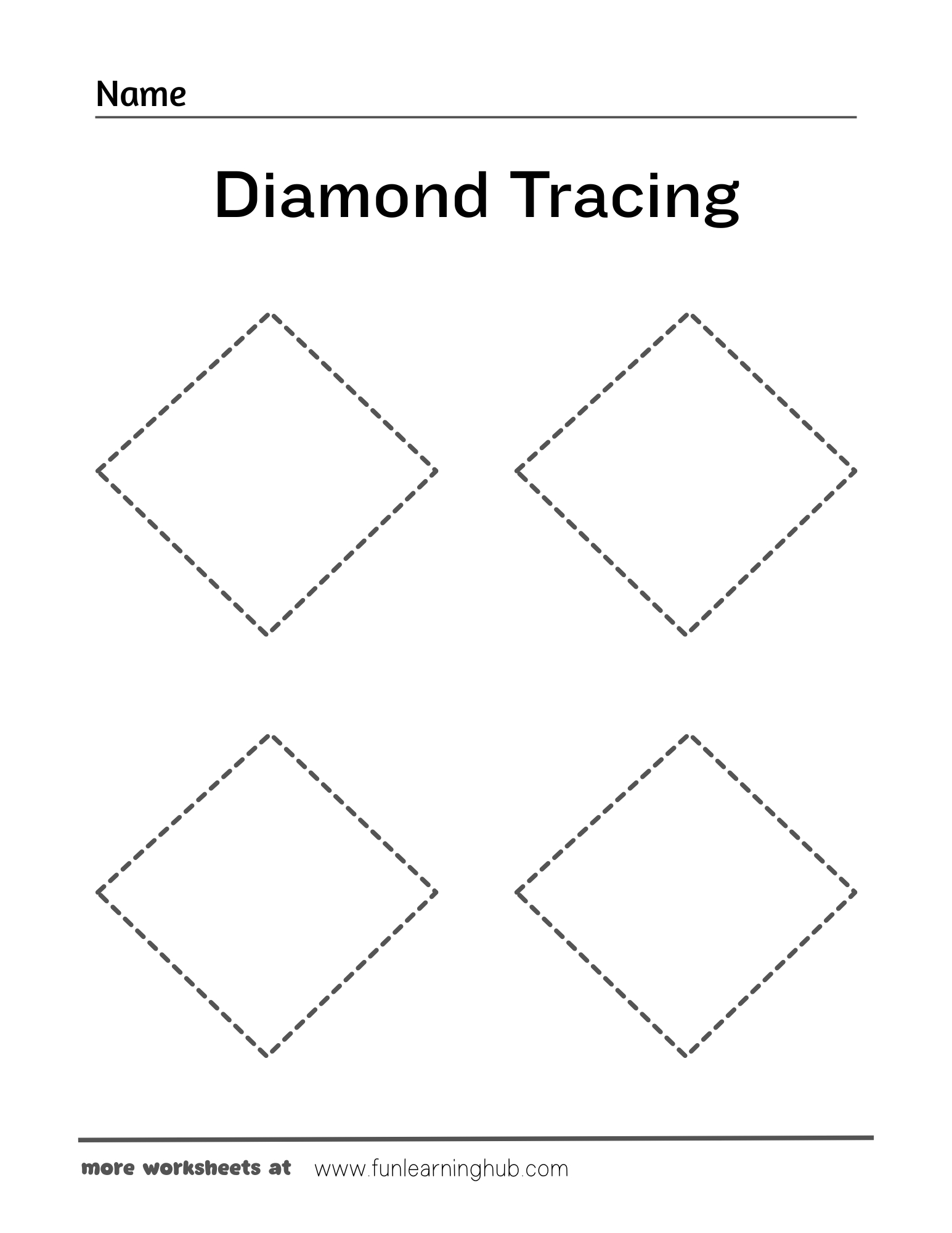
The tracing diamonds worksheet focuses heavily on diagonal line coordination, acute angle navigation, and continuous pencil strokes. Unlike basic vertical or horizontal lines, a diamond forces the hand to change direction four distinct times while maintaining visual contact with the paper. This sheet bridges the gap between basic Shape and Line Tracing and letter formation, providing targeted practice for shapes that feature slanting lines, such as uppercase A, K, V, W, and X. Working through these distinct geometric patterns helps children understand how to decelerate around corners and accelerate along straight paths.
Key Learning Outcomes
Engaging with this printable directly improves visual-motor integration, bilateral coordination, and spatial awareness. As little hands guide writing utensils around the four sharp corners, finger dexterity and intrinsic hand muscle strength improve significantly. Furthermore, children develop better motor planning, which allows them to execute complex directional shifts smoothly without lifting the pencil prematurely. These foundational outcomes support broader Fine Motor and Pre-Writing Skills that translate directly into neater handwriting and improved drawing capabilities later on.
How to Use This Worksheet
Successful implementation begins with setting up an ergonomic workspace where the feet flatly touch the floor and the table sits at elbow height. Start by having the child trace the large diamond outlines using an index finger to build kinesthetic memory before introducing a writing tool. Encourage a functional tripod grasp, but keep the atmosphere low-pressure to prevent hand fatigue and frustration. Adults can gently guide the child’s hand through the first few tricky corners to model the required deceleration and directional shift.
Practical Tips for Parents and Teachers
Scaffolding the experience makes all the difference when frustration peaks during those tricky acute angles. For children who struggle with pencil pressure, placing the worksheet over a textured surface or a wedge board can provide valuable sensory feedback. According to the National Association for the Education of Young Children, active scaffolding during motor skill acquisition helps children transition safely from supported practice to independent mastery. If a child tires quickly, use thick crayons or short golf pencils to encourage an optimal grasp naturally. To extend the activity, let children cut along the traced diamond lines with safety scissors to build bilateral hand integration.
Age-Appropriate Recommendations
For toddlers and preschoolers aged two to four, diamonds represent an advanced geometric challenge that requires scaffolding through finger-tracing and tactile fill-in activities before touching a pencil. During the kindergarten and early elementary years spanning ages five to eight, children align with the National Association for the Education of Young Children DAP standards by independently executing diagonal lines, maintaining correct stroke sequence, and demonstrating reliable hand dominance during complex geometric tracing tasks.
Proficiency in geometric shape tracing at preschool age strongly correlates with later spatial reasoning and handwriting fluency — American Occupational Therapy Association
Frequently Asked Questions
Finding the right guidance for early childhood skill development helps adults support children more effectively at home and inside the classroom.
Explore More Free Printable Tracing Worksheets
Building a robust foundation for early literacy and writing takes a varied collection of engaging practice materials. Alongside geometric shapes, expanding practice into Alphabet And Numbers Tracing ensures well-rounded motor development. Educators and families can explore the full library of resources at KidTraces.com to find supportive printables tailored to every developmental milestone.
Developmental Milestone & Activity Table
| Development Stage | Recommended Daily Duration | Primary Learning Objective |
|---|---|---|
| Preschool & Pre-K | 10 – 15 Minutes | Pencil grip development & basic pre-stroke lines |
| Kindergarten | 15 – 20 Minutes | Letter/number formation & spatial line awareness |
| Early Elementary (Grade 1–2) | 20 – 30 Minutes | Fluency, sentence construction & neatness |
Images References