Introduction
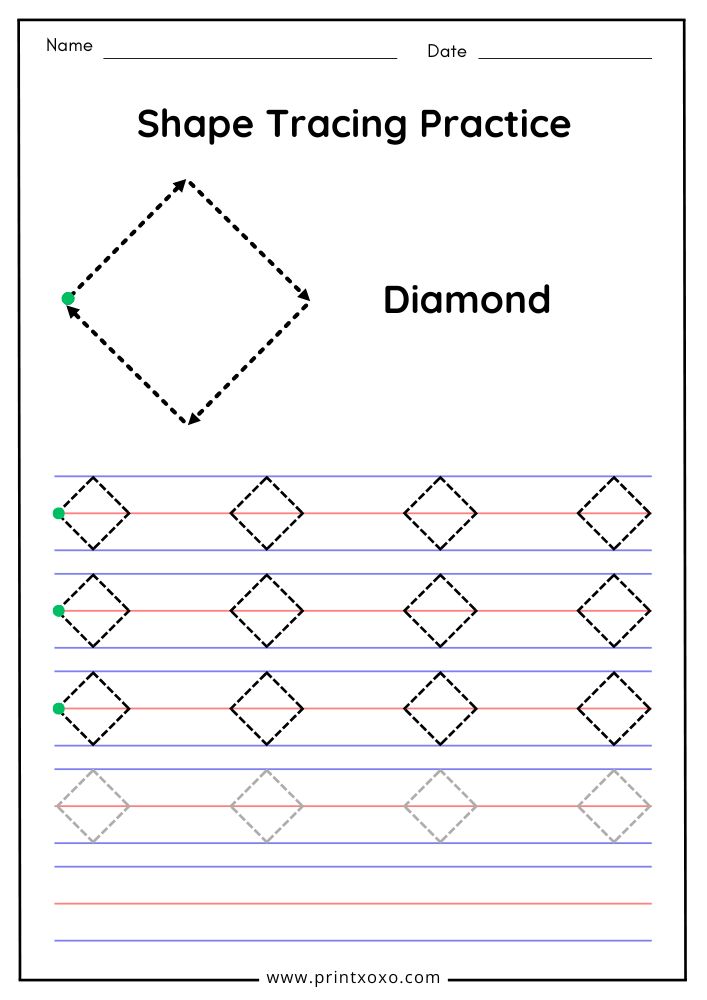
Many children recognize letters, numbers, and geometric forms long before their fine motor skills can actually form them on paper. According to the American Occupational Therapy Association, foundational pencil control and fine motor manipulation rely heavily on early visual-motor integration and upper extremity stability. Traditional pencil-and-paper tasks often frustrate young learners when introduced too abruptly. Shape mastery bridges this developmental gap. The diamond tracing preschool worksheet provides a structured, visually engaging pathway for young learners to master complex diagonal strokes, directional changes, and bilateral hand coordination without the pressure of traditional handwriting drills.
💡 Educational Key Takeaways:
- Core Skill: Structured Diamond Tracing Preschool focused on developing pencil grip, stroke control, and early literacy/math confidence.
- Target Scope: Suited for homeschoolers, preschool, kindergarten, and elementary learners.
- Best Recommendation: Practice 10–15 minutes daily with ergonomic writing tools to reinforce muscle memory without hand fatigue.
What This Worksheet Covers
Mastering a diamond shape requires a specific combination of slanted lines, continuous motion, and precise corner control that sets the neurological foundation for future letters like ‘v’, ‘w’, ‘k’, and ‘x’. Slanted lines demand much higher visual-spatial processing than vertical or horizontal lines, challenging the brain to coordinate hand movements along non-linear paths. This specific resource focuses on breaking down the diamond into manageable visual segments, utilizing dotted lines and directional arrows to guide pencils smoothly across the page. It sounds simple, and that’s the point. By focusing purely on shape geometry, children refine hand-eye coordination and spatial awareness before tackling complex letter combinations found in resources like Alphabet And Numbers Tracing.
Key Learning Outcomes
Children engaging with this diamond layout systematically build vital pre-writing competencies. First, learners develop directional control by practicing continuous downward and upward diagonal strokes without lifting the writing utensil. Second, the activity reinforces bilateral integration, stabilizing the paper with one hand while the dominant hand executes precise pencil movements. Third, navigating sharp angles teaches children how to decelerate, pivot, and accelerate, mirroring the exact motor planning required for complex Shape and Line Tracing activities. Finally, repeated exposure builds intrinsic muscle memory in the small intrinsic muscles of the hand, paving the way for smooth progressions into Dotted Letters For Tracing.
How to Use This Worksheet
Successful implementation relies heavily on environmental setup and low-stress pacing. Educators and caregivers should begin by placing the worksheet on a flat, stable surface at a comfortable height, ensuring the child’s feet rest flat on the floor to promote core stability. Encourage tracing with a variety of tactile mediums before moving to standard pencils; crayons, short markers, or even finger paints in a tray provide excellent sensory feedback. It is entirely normal for young hands to grip the pencil too tightly or revert to a fist grasp when navigating difficult corners. Gentle, positive redirection works wonders for building confidence during these challenging geometric exercises.
Practical Tips for Parents and Teachers
Here’s what makes this worksheet different: it emphasizes process over perfection. Adults should explicitly model the stroke starting point, demonstrating how to pause at the bottom vertex before changing direction upward. Scaffolding the activity helps prevent hand fatigue; limit tracing sessions to five or ten minutes per sitting to keep engagement high. For advanced learners, challenge them to trace the diamond using non-dominant hands or cover the dotted lines halfway through to encourage independent visual tracking. Celebrating small victories, such as a smoother corner pivot or maintaining a steady tripod grasp, reinforces a growth mindset and keeps the learning experience joyful.
Age-Appropriate Recommendations
According to the CDC developmental milestones, children aged two to four are typically refining pre-writing strokes such as vertical and horizontal lines, making large-scale finger tracing or thick crayon trials ideal for this age group. By ages five through eight, aligned with the National Association for the Education of Young Children guidelines for developmentally appropriate practice, children should refine pencil grips and execute controlled diagonal lines independently. This particular diamond activity scales easily across both developmental stages, functioning as an accessible introduction for preschoolers or a precision pencil-control drill for early elementary students exploring the broader library of Fine Motor and Pre-Writing Skills.
Foundational pencil control and fine motor manipulation rely heavily on early visual-motor integration and upper extremity stability. — American Occupational Therapy Association (AOTA)
Frequently Asked Questions
Quick answers regarding the implementation, downloading, and developmental benefits of diamond tracing sheets help caregivers maximize learning outcomes at home or in the classroom.
Young children often recognize letters long before their fine motor skills can form them on paper, making shape tracing an essential developmental bridge. — Early Childhood Literacy Research
Explore More Free Printable Tracing Worksheets
Supporting a child’s handwriting journey requires a diverse array of engaging, no-prep resources tailored to every developmental milestone. Beyond geometric shapes, learners can explore exciting topics, seasonal activities, and structured handwriting modules across the entire collection available at KidTraces.com. Whether preparing a toddler for their first pencil strokes or helping a kindergartener master stroke order, these curated tools make learning fun, accessible, and effective. Discover additional printables designed to inspire young writers by browsing through Tracing Worksheets.
Developmental Milestone & Activity Table
| Development Stage | Recommended Daily Duration | Primary Learning Objective |
|---|---|---|
| Preschool & Pre-K | 10 – 15 Minutes | Pencil grip development & basic pre-stroke lines |
| Kindergarten | 15 – 20 Minutes | Letter/number formation & spatial line awareness |
| Early Elementary (Grade 1–2) | 20 – 30 Minutes | Fluency, sentence construction & neatness |
Images References