Introduction
Many children recognize letters, numbers, and geometric forms long before their developing fine motor skills possess the strength and control required to recreate them on paper. According to the American Occupational Therapy Association, foundational fine motor control and bilateral coordination are essential prerequisites for functional handwriting and classroom success. Mastering geometric forms serves as a critical bridge between simple scribbling and complex letter formation. Integrating targeted materials like the tracing diamond shape free printable into daily routines gives young learners the structured repetition they need to build pencil control. Geometric shapes demand distinct directional changes, oblique lines, and spatial awareness that straight vertical or horizontal strokes simply do not require. It sounds simple, and that is precisely the point. By focusing on single, well-designed shapes, adults can help children conquer the specific visual-motor challenges that underpin all future writing tasks. Exploring resources housed within the broader Shape and Line Tracing archive offers endless opportunities for targeted skill reinforcement.
💡 Educational Key Takeaways:
- Core Skill: Structured Tracing Diamond Shape Free Printable focused on developing pencil grip, stroke control, and early literacy/math confidence.
- Target Scope: Suited for homeschoolers, preschool, kindergarten, and elementary learners.
- Best Recommendation: Practice 10–15 minutes daily with ergonomic writing tools to reinforce muscle memory without hand fatigue.
What This Worksheet Covers
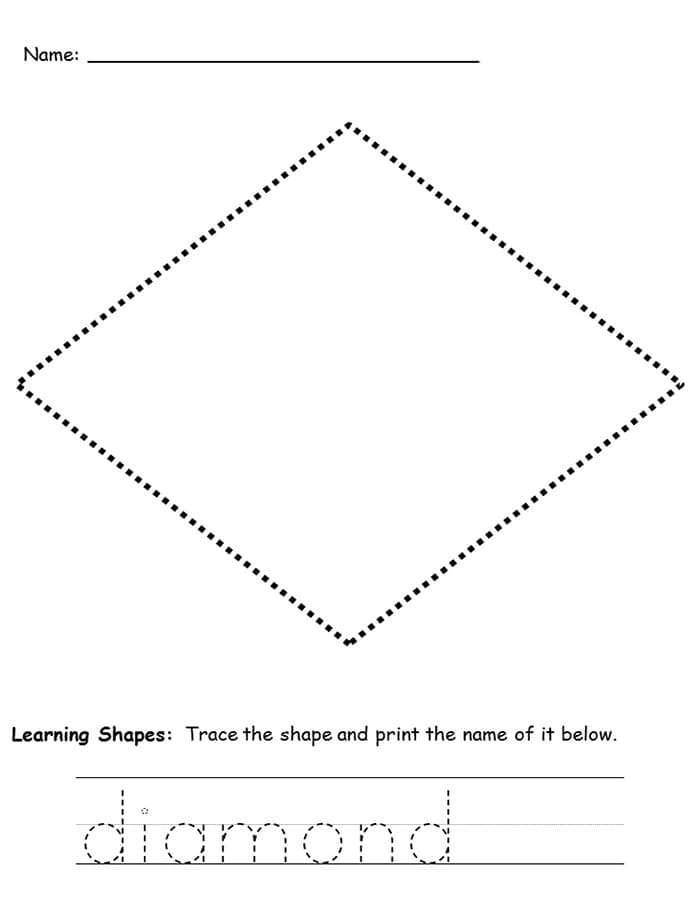
This specific printable focuses exclusively on mastering the oblique strokes necessary to construct a clean, balanced diamond shape. The worksheet features large, directional-guided dotted lines that demonstrate the precise starting point and continuous path required for successful execution. Children encounter frequent roadblocks when attempting diagonal lines because the human hand naturally gravitates toward sweeping arcs rather than sharp angles. Addressing this hurdle requires intentional practice with forms that force the wrist and fingers to navigate corners and abrupt directional shifts. The layout minimizes visual clutter, ensuring that young learners maintain focus without becoming overwhelmed by excessive stimuli on a single page. Incorporating this targeted exercise strengthens the exact muscle groups utilized in the Fine Motor and Pre-Writing Skills domain, laying a solid foundation for academic readiness.
Key Learning Outcomes
Working through this geometric tracing exercise builds foundational competencies that extend far beyond simple shape recognition. Learners develop advanced visual-motor integration as their eyes guide their hands along precise diagonal paths. Hand strength and endurance improve incrementally as fingers maintain a consistent grasp to navigate the four distinct corners of the diamond. Directionality and spatial orientation receive a significant boost, helping children understand concepts like top, bottom, left, and right in a tangible, physical way. Pencil pressure regulation also improves organically, moving children away from exhausting white-knuckle grips toward smooth, fluid control. These cumulative benefits ensure a seamless transition when moving on to more complex tasks found throughout the Tracing Worksheets collection.
How to Use This Worksheet
Maximizing the effectiveness of this printable requires more than simply handing a child a pencil and pointing to the paper. Adults should begin by observing the child’s natural grip, offering gentle adjustments to encourage a functional tripod or quadrupod grasp if fingers are wrapped too tightly. Positioning the paper at a slight angle that matches the natural arc of the child’s forearm can dramatically improve comfort and accuracy during execution. Encouraging the learner to trace the shape first with an index finger provides crucial tactile feedback before metal or graphite touches the page. Laminating the sheet or slipping it inside a dry-erase sleeve transforms a single-use paper into a reusable center activity, reducing pressure and encouraging playful experimentation without the fear of making permanent mistakes.
Practical Tips for Parents and Teachers
Scaffolding the learning process prevents frustration and keeps motivation high during challenging skill acquisition phases. Adults can demonstrate the tracing motion in the air, exaggerating the sharp downward and upward diagonal strokes with dramatic arm movements. Verbalizing the path using fun, descriptive cues like sliding down the mountain and climbing back up helps anchor the visual path in the child’s memory. For children who struggle with pencil stamina, breaking the exercise into smaller segments across multiple days ensures positive engagement rather than fatigue. When learners show mastery over basic geometric forms, educators can seamlessly extend the learning by pairing this activity with companion exercises from the Alphabet And Numbers Tracing section to connect shape control with letter creation.
Age-Appropriate Recommendations
Child development guidelines, including the National Association for the Education of Young Children Developmentally Appropriate Practice framework, emphasize that fine motor expectations must match the biological readiness of the child. For toddlers and preschoolers aged two to four, the focus should remain on large-scale motor control, finger warm-ups, and tracing very large outlines using thick crayons or markers. At this stage, expecting perfection is counterproductive; the goal is simply engaging the wrist and elbow in directional movement. For older children aged five to eight, the expectations shift toward precision, pencil control, proper stroke sequence, and maintaining consistent line pressure. Within this older cohort, mastering a diamond shape serves as a direct precursor to writing uppercase letters like A, V, M, and W, which rely heavily on identical diagonal stroke patterns.
According to the Centers for Disease Control and Prevention developmental milestones, children typically develop the ability to copy a cross and imitate basic shapes like squares and triangles between the ages of three and four, laying the groundwork for complex diagonal forms like diamonds by early elementary school. — CDC
Frequently Asked Questions
Clear answers to common questions help caregivers implement these foundational exercises with confidence and ease at home or in the classroom.
Explore More Free Printable Tracing Worksheets
Supporting a child’s early educational journey involves providing a diverse variety of engaging, low-pressure practice materials that adapt to individual growth and changing skill levels. Every child moves at a unique pace, and having access to a comprehensive library of resources ensures that learning remains an enjoyable, rewarding daily adventure. Caregivers and educators can discover an extensive selection of completely free educational materials designed to support early development by exploring the main resource hub at KidTraces.com today.
Developmental Milestone & Activity Table
| Development Stage | Recommended Daily Duration | Primary Learning Objective |
|---|---|---|
| Preschool & Pre-K | 10 – 15 Minutes | Pencil grip development & basic pre-stroke lines |
| Kindergarten | 15 – 20 Minutes | Letter/number formation & spatial line awareness |
| Early Elementary (Grade 1–2) | 20 – 30 Minutes | Fluency, sentence construction & neatness |
Images References