Introduction
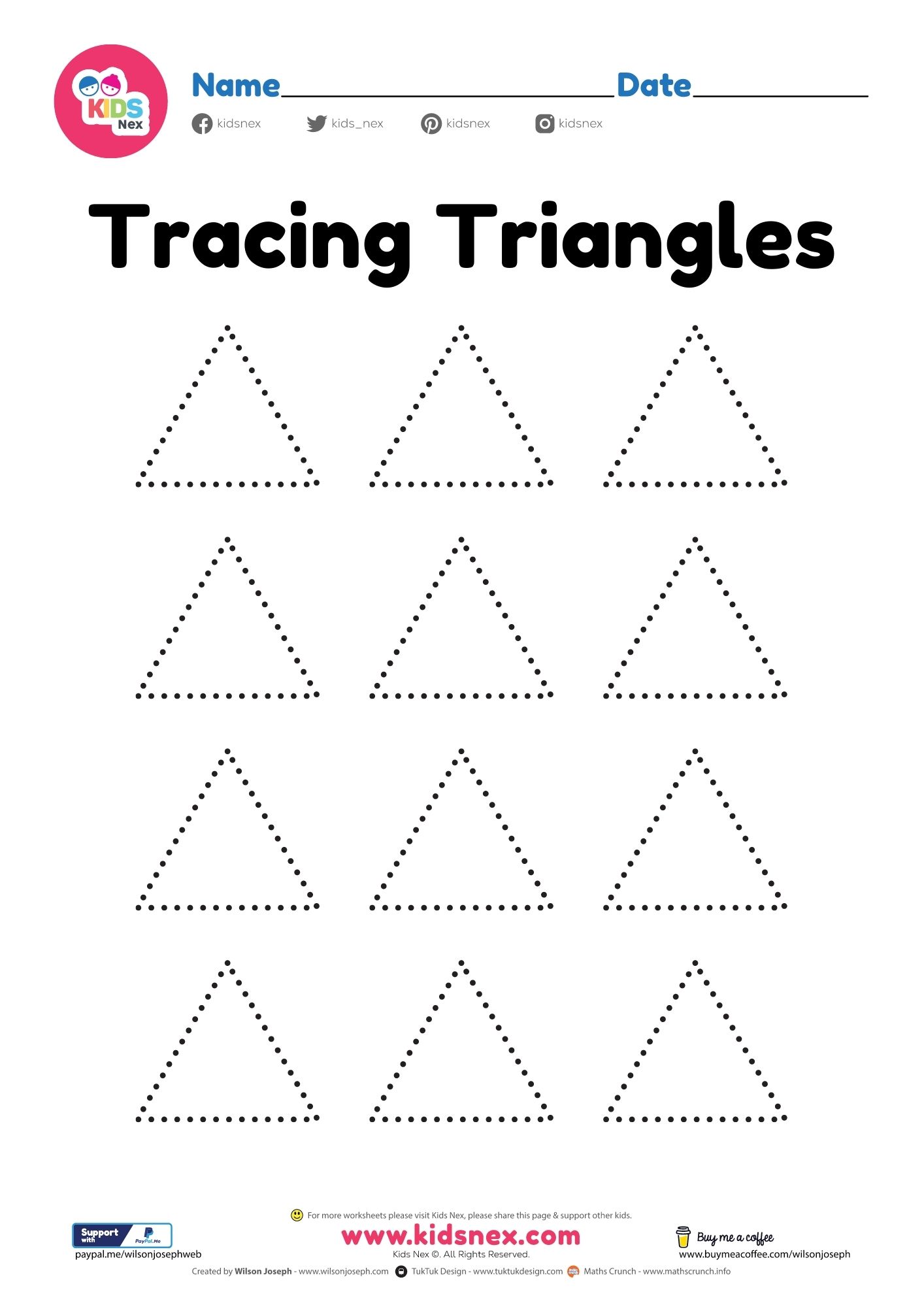
Many children recognize letters, numbers, and geometric forms long before their fine motor control allows them to replicate those shapes on paper. According to the American Occupational Therapy Association, foundational fine motor skills—such as hand strength, bilateral coordination, and finger dexterity—must develop sequentially to support efficient handwriting and tool use later in childhood. Mastering these physical milestones requires targeted practice that bridges visual recognition with muscular endurance. The free printable tracing triangles worksheet provides an ideal bridge for this developmental gap. It sounds simple, and that is precisely the point. By focusing on sharp corners, diagonal lines, and controlled directional shifts, children build the foundational muscle memory required for complex pre-writing tasks without the cognitive overload of forming abstract letters. Explore more in our Shape and Line Tracing collection.
💡 Educational Key Takeaways:
- Core Skill: Structured Tracing Triangles focused on developing pencil grip, stroke control, and early literacy/math confidence.
- Target Scope: Suited for homeschoolers, preschool, kindergarten, and elementary learners.
- Best Recommendation: Practice 10–15 minutes daily with ergonomic writing tools to reinforce muscle memory without hand fatigue.
What This Worksheet Covers
This specific printable targets the fundamental pre-writing strokes that form the backbone of both geometry and handwriting. Triangles introduce diagonal lines, which require significantly more muscular control from the hand and wrist than simple horizontal or vertical strokes. While curved lines rely on smooth fluid motions, triangles demand deliberate stopping points, precise angle navigation, and intentional direction changes at every vertex. Practitioners often observe that corners trip up young learners because they require a momentary pause, a shift in weight distribution on the pencil, and a deliberate recalculation of the hand path. Working through these geometric shapes strengthens visual-spatial perception while training the hand to maintain consistent pressure during directional shifts. These exact mechanical movements transfer directly to forming uppercase letters like A, M, V, and W. For more related activities, check out our Sensotyline Tracing.
Key Learning Outcomes
Learners engaging with these pages develop enhanced pencil control by practicing smooth transitions across intersecting diagonal boundaries. Hand-eye coordination improves naturally as young eyes guide small hands around the distinct three-point perimeters of the shapes. According to the National Association for the Education of Young Children, purposeful play and structured graphic practice during early childhood build the neural pathways necessary for complex spatial reasoning and literacy readiness. Spatial awareness deepens as children learn to judge relative sizes, center points, and boundary limits on the page. Finally, completing these geometric patterns fosters sustained attention to detail, encouraging learners to follow a continuous line from starting points to completion without lifting the writing tool prematurely.
How to Use This Worksheet
Preparation and environment dictate the success of any fine motor activity involving young children. Setting up a supportive workstation begins with ensuring the table height allows the child’s feet to rest flat on the floor and elbows to bend at a comfortable ninety-degree angle. Securing the paper with low-tack painter tape prevents frustration caused by slipping pages, which is especially helpful for children who stabilize with their non-dominant hand. Before placing pencils in tiny hands, invite tracing with a finger to map the physical path of the triangle in the air or directly over the printed page. This kinesthetic preview activates muscle memory before the pencil ever touches the paper, reducing hesitation and encouraging fluid motion.
Practical Tips for Parents and Teachers
Adults play a vital role in scaffolding these exercises by modeling proper pencil grip and offering gentle encouragement during challenging corners. If a child demonstrates a tight, fisted grip, introduce short-barreled crayons or golf pencils, which naturally encourage a functional tripod or quadrupod grasp by discouraging over-extension. Scaffold the activity by starting with larger, finger-trailed versions before moving to standard pencils and thinner printed outlines. When extending the challenge for more advanced learners, encourage them to trace the triangles while alternating colors or timing their strokes to build endurance. Avoid correcting every slight deviation from the dotted line; instead, celebrate the intentional effort and the physical act of completing the shape from corner to corner.
Age-Appropriate Recommendations
Developmental expectations must align with physical capabilities rather than chronological age alone. For toddlers and preschoolers aged two to four, align practice with the CDC developmental milestones by offering large-scale triangles paired with thick-barreled writing tools to accommodate emerging palmar and digital grasps. At this stage, focus entirely on gross directional control rather than rigid perfection. For kindergarteners and early elementary students aged five to eight, align activities with the Common Core ELA standard CCSS.ELA-LITERACY.L.K.1.A, which emphasizes printing all upper- and lowercase letters cleanly. Older children can utilize these geometric sheets to refine wrist stability, improve pencil pressure regulation, and master the sharp angles required for crisp, legible handwriting across the curriculum.
Foundational fine motor skills, including hand strength and bilateral coordination, must develop sequentially to support efficient handwriting and daily functional tasks. — American Occupational Therapy Association (AOTA)
Frequently Asked Questions
Navigating early childhood writing resources is simpler with clear, direct guidance for adults supporting young learners.
Explore More Free Printable Tracing Worksheets
Expanding a child’s skill set requires a diverse library of practice materials tailored to every developmental stage. Beyond geometric shapes, learners can explore the expansive collection available through KidTraces.com to find targeted support. Strengthen foundational hand muscles by browsing the Fine Motor and Pre-Writing Skills section. Guide early letter formation with the Dotted Letters For Tracing pages, or build numeric fluency using the Tracing Number resources. Keep practice engaging throughout the changing calendar year by exploring the Seasonal and Fun Themes gallery. Every child progresses at their own pace, and having access to varied, high-quality printables ensures learning remains joyful, supportive, and effective.
Developmental Milestone & Activity Table
| Development Stage | Recommended Daily Duration | Primary Learning Objective |
|---|---|---|
| Preschool & Pre-K | 10 – 15 Minutes | Pencil grip development & basic pre-stroke lines |
| Kindergarten | 15 – 20 Minutes | Letter/number formation & spatial line awareness |
| Early Elementary (Grade 1–2) | 20 – 30 Minutes | Fluency, sentence construction & neatness |
Images References