Introduction
Toddlers often grip crayons with an entire fist long before attempting to form standard letters or numbers, signaling that early handwriting preparation begins with gross arm movements and large geometric outlines. According to the American Occupational Therapy Association, foundational fine motor control develops sequentially as children master proximal stability in the shoulder and elbow before gaining precise distal control in the fingers and hands. Many adults assume that formal writing begins with alphabet worksheets, yet clinical observations reveal that young children recognize visual shapes and lines long before their hand muscles can sustain the pressure required for traditional pencil tasks. Tracing shapes for 2 years old bridges this critical developmental gap, offering a gentle introduction to pre-writing strokes through large, inviting geometric boundaries. It sounds simple, and that is the exact point of early childhood motor intervention.
💡 Educational Key Takeaways:
- Core Skill: Structured Tracing Shapes For 2 Years Old focused on developing pencil grip, stroke control, and early literacy/math confidence.
- Target Scope: Suited for homeschoolers, preschool, kindergarten, and elementary learners.
- Best Recommendation: Practice 10–15 minutes daily with ergonomic writing tools to reinforce muscle memory without hand fatigue.
What This Worksheet Covers
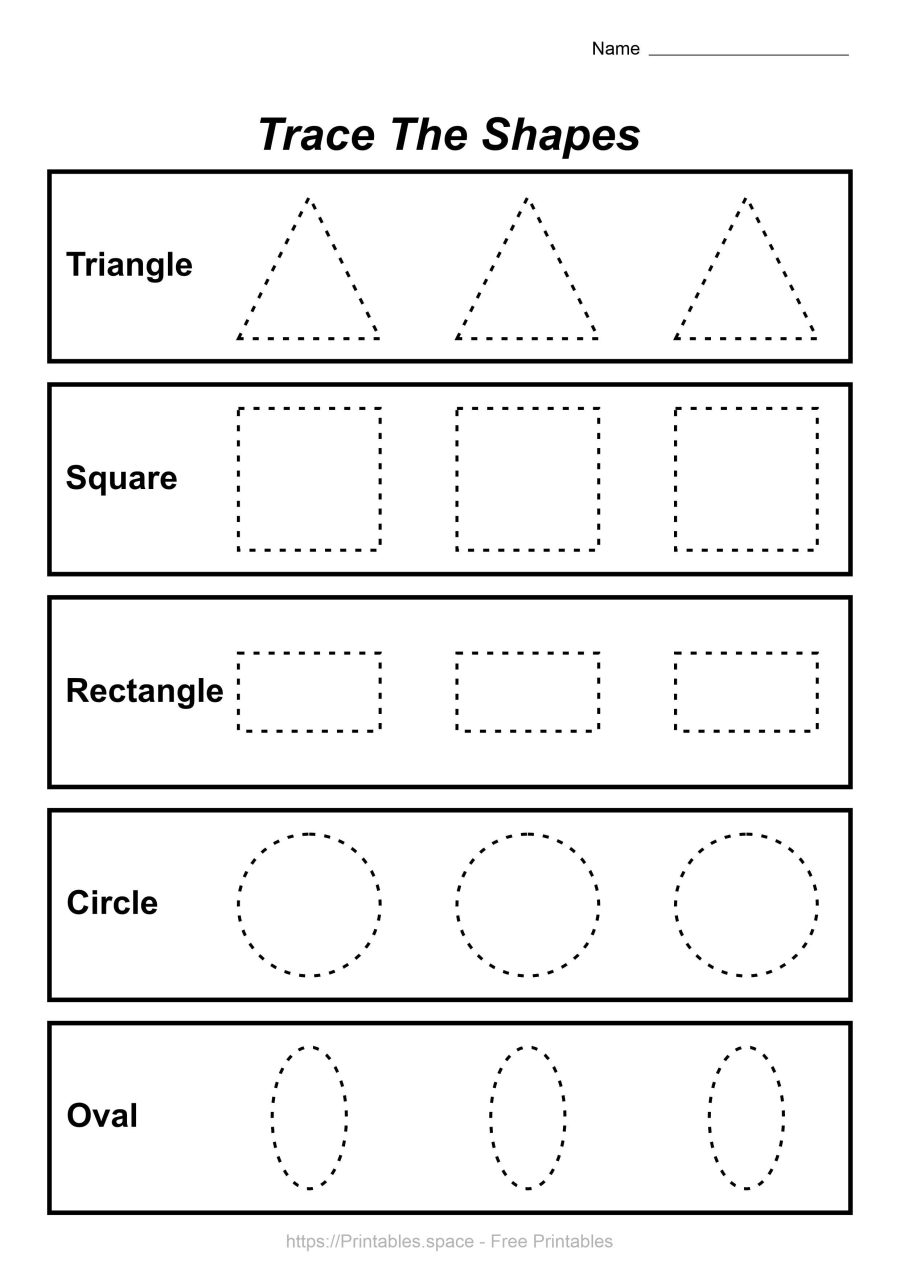
This printable resource focuses on foundational pre-writing strokes, directional tracking, and visual-motor integration through the exploration of basic closed geometric figures. Children encounter thick, continuous outlines of circles, squares, and triangles designed specifically for toddler-sized exploratory movements. Rather than demanding strict adherence to thin dotted lines, the design accommodates early visual-motor coordination stages where wandering outside the boundary remains a normal part of neurological and physical maturation. Exploring these foundational designs builds the visual tracking capacity necessary for future reading and writing tasks found across Shape and Line Tracing collections. Every page encourages repeated trials without the pressure of perfection, allowing young learners to build confidence in controlling a writing tool across a flat surface.
Key Learning Outcomes
Engaging regularly with these early geometric sheets fosters significant neurological and physical growth in developing children. Hand-eye coordination improves dramatically as tiny eyes track a curved or straight line while the hand attempts to mirror that trajectory on paper. Bilateral coordination strengthens naturally because one hand stabilizes the sheet while the dominant hand executes the drawing motion. Spatial awareness expands as toddlers learn to perceive boundaries, corners, and continuous loops within a defined visual field. Furthermore, sustained concentration increases through brief, highly engaging bouts of targeted marking and tracing, which lays the groundwork for broader Fine Motor and Pre-Writing Skills needed later in preschool.
How to Use This Worksheet
Adults can maximize the benefit of this resource by adapting the physical medium to match the developmental readiness of the individual child. Thick wax crayons, chunky triangular markers, or even fingerpainting directly over laminated sheets offer sensory feedback that thin graphite pencils simply cannot provide at age two. Placing the paper on a vertical easel or a slanted board activates shoulder and wrist extension, positioning the hand in an anatomically advantageous posture for future pencil grasps. Here is what makes this approach different: success is measured by engagement and exploratory joy rather than accurate line retention. Caregivers should encourage freehand sweeping motions across the shapes, treating mistakes as playful discoveries rather than errors to be corrected.
Practical Tips for Parents and Teachers
Modelling appropriate tool manipulation without forcing an unnatural adult grasp helps children transition organically from a palmar fist to a digital pronate or transitional tripod grip. Scaffolding the experience involves starting with large, continuous circles before introducing angular shapes like squares, since circular motions align more closely with natural toddler arm movements. Adults can extend the learning by having toddlers trace physical shapes in the air, in shaving cream, or across textured surfaces before returning to paper. Keeping practice sessions short—typically three to five minutes—prevents hand fatigue and frustration, ensuring that writing remains a positive, anticipated daily activity.
Age-Appropriate Recommendations
According to the CDC developmental milestones, children around age two typically imitate vertical strokes and circular scribbles, making large shape outlines an ideal match for their emerging motor capabilities. During the toddler years, the emphasis stays firmly on movement exploration, sensory engagement, and large-scale visual tracking rather than formal letter formation. As children transition into preschool and early elementary grades under frameworks like NAEYC Developmentally Appropriate Practice, these early shape experiences evolve into structured pre-writing lines, letter tracing, and eventually comprehensive Tracing Worksheets that prepare them for formal academic writing instruction.
Foundational motor control develops sequentially as children master proximal stability in the shoulders and core before gaining precise distal control in the fingers and hands. — American Occupational Therapy Association
Frequently Asked Questions
Clear guidance helps educators and families implement these printable resources effectively at home or within early childhood classroom environments.
Explore More Free Printable Tracing Worksheets
Supporting a young child’s journey toward independent writing requires a diverse toolkit of engaging, developmentally appropriate resources that grow alongside developing hands. Families, educators, and homeschoolers can discover a vast assortment of guided practice materials covering everything from early stroke control to complex letter formations by exploring the complete library available at KidTraces.com. Whether transitioning toward the Alphabet And Numbers Tracing section or diving into specialized practice through Word and Name Tracing, every printable is designed to make foundational skill development joyful, accessible, and entirely free.
Developmental Milestone & Activity Table
| Development Stage | Recommended Daily Duration | Primary Learning Objective |
|---|---|---|
| Preschool & Pre-K | 10 – 15 Minutes | Pencil grip development & basic pre-stroke lines |
| Kindergarten | 15 – 20 Minutes | Letter/number formation & spatial line awareness |
| Early Elementary (Grade 1–2) | 20 – 30 Minutes | Fluency, sentence construction & neatness |
Images References