Introduction
Many young children recognize letters long before their fine motor skills can actually form them. This common developmental gap often frustrates adults who rush straight into letter formation without laying the necessary groundwork. According to the American Occupational Therapy Association, foundational visual-motor and postural skills must be established before children can successfully manipulate writing tools for academic tasks. Diagonal line tracing bridges this gap perfectly. It sounds simple, and that is the point. Mastering slanted lines prepares tiny hands for the complex geometric intersections found in capital letters and numbers. Exploring these pre-writing foundations requires targeted resources like the free printable Shape and Line Tracing collection, which isolates individual strokes to build muscle memory without overwhelming the learner.
💡 Educational Key Takeaways:
- Core Skill: Structured Diagonal Line Tracing focused on developing pencil grip, stroke control, and early literacy/math confidence.
- Target Scope: Suited for homeschoolers, preschool, kindergarten, and elementary learners.
- Best Recommendation: Practice 10–15 minutes daily with ergonomic writing tools to reinforce muscle memory without hand fatigue.
What This Worksheet Covers
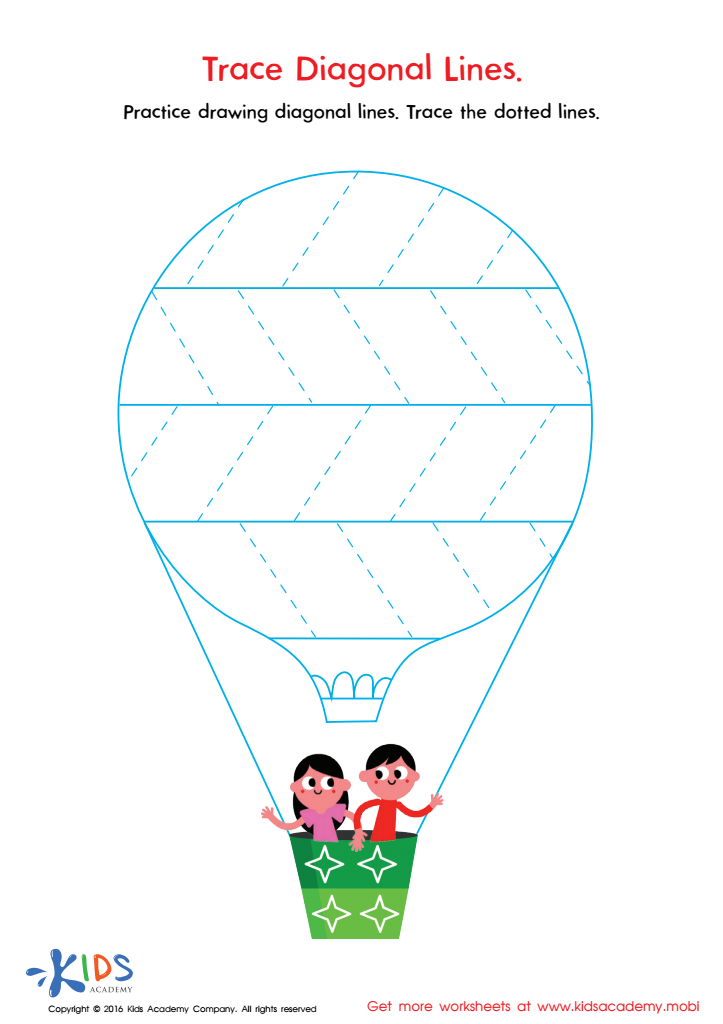
The free printable diagonal line tracing sheet targets the exact oblique strokes that children struggle with during early writing instruction. Vertical and horizontal lines come naturally around age three because they mimic sweeping arm movements, but diagonals require crossing the body’s midline and coordinating the visual-motor system in new ways. This page guides pencils along gentle slopes, sharp zigzags, and intersecting slant patterns. Every pathway challenges the brain to map spatial relationships while teaching the hand how to sustain controlled pressure. It serves as an essential stepping stone within the broader category of Fine Motor and Pre-Writing Skills, ensuring that early learners develop the dexterity required for effortless pencil control.
Key Learning Outcomes
Working through these slanted tracks develops visual tracking, hand-eye coordination, and bilateral integration as the hand crosses the visual field. Children build intrinsic hand muscle strength and improve dynamic tripod grasp endurance by maintaining continuous contact with the paper. Furthermore, learners internalize directional awareness, learning to track movement from top to bottom and left to right with intention. These neurological and physical gains translate directly into smoother handwriting performance later on, reducing hand fatigue during extended classroom writing tasks.
How to Use This Worksheet
Success with pre-writing pages relies heavily on presentation and pacing rather than strict drilling. Adults should introduce the page as a playful maze or a mountain-climbing game rather than an academic chore. Starting with a finger trace allows the brain to map the trajectory before the pencil touches the page, which dramatically reduces stray marks and frustration. If fatigue sets in after a few lines, stop immediately and return to the activity later. Building positive associations with pencil tasks is just as important as mastering the stroke itself, a philosophy heavily emphasized in specialized collections like Tracing Worksheets.
Practical Tips for Parents and Teachers
Adults play a vital scaffolding role during early tracing sessions by modeling proper grip and posture before handing over the crayon or pencil. Encourage a relaxed, functional grasp where the thumb and index finger pinch the tool while it rests comfortably on the middle finger. If a child struggles with hand weakness, taping the printable to a slanted surface or a vertical easel naturally activates the wrist extension needed for optimal pencil control. According to the National Association for the Education of Young Children guidelines on developmentally appropriate practice, educators should always prioritize process over perfection, celebrating steady effort and incremental control rather than flawless adherence to the dotted path.
Age-Appropriate Recommendations
For toddlers and preschoolers aged two to four, focus exclusively on large-scale diagonal movements using thick crayons, paintbrushes, or finger-tracing directly over laminated sheets. At this stage, according to CDC developmental milestones, children are just beginning to imitate vertical and horizontal strokes, meaning diagonals require patience and low expectations. By ages five to eight, children transition to standard pencils and smaller, more complex intersecting diagonal patterns. This older group benefits from refining their pressure modulation and precision, preparing them for formal handwriting instruction where proper stroke order and line placement become paramount.
Foundational visual-motor skills must be established before children can successfully manipulate writing tools for academic tasks. — American Occupational Therapy Association
Frequently Asked Questions
Common questions regarding diagonal line tracing center on preparation, printing, and developmental readiness. The answers below provide direct, actionable guidance for supporting young writers at home or in the classroom.
Explore More Free Printable Tracing Worksheets
Building confident writers takes time, patience, and a diverse library of engaging practice materials. Beyond diagonal line instruction, young learners benefit immensely from exploring varied stroke patterns, letters, numbers, and themed pages that keep motivation high. Every child moves at their own unique pace, and having access to a broad selection of targeted printables makes it easy to meet individual needs. Discover the full library of resources by visiting KidTraces.com to support every step of the early writing journey.
Developmental Milestone & Activity Table
| Development Stage | Recommended Daily Duration | Primary Learning Objective |
|---|---|---|
| Preschool & Pre-K | 10 – 15 Minutes | Pencil grip development & basic pre-stroke lines |
| Kindergarten | 15 – 20 Minutes | Letter/number formation & spatial line awareness |
| Early Elementary (Grade 1–2) | 20 – 30 Minutes | Fluency, sentence construction & neatness |
Images References