Introduction
Watch any group of preschoolers attempt to write their names, and a common pattern emerges almost immediately: hands grip crayons with tightly balled fists, knuckles whiten, and markers stray wildly across the page. Many children recognize letters, numbers, and shapes long before their fine motor systems and postural core strength possess the readiness required to form them on paper. According to the National Association for the Education of Young Children, early childhood curriculum must intentionally integrate meaningful physical manipulation and pre-writing experiences to build foundational hand strength. Mastering horizontal tracking and directional control remains a cornerstone of this developmental journey. The free printable Shape and Line Tracing activities provide a structured, engaging bridge between visual tracking and physical pencil control.
💡 Educational Key Takeaways:
- Core Skill: Structured Tracing Lines From Left To Right focused on developing pencil grip, stroke control, and early literacy/math confidence.
- Target Scope: Suited for homeschoolers, preschool, kindergarten, and elementary learners.
- Best Recommendation: Practice 10–15 minutes daily with ergonomic writing tools to reinforce muscle memory without hand fatigue.
What This Worksheet Covers
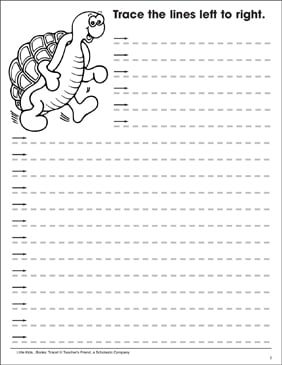
Horizontal tracking mechanics form the primary focus of these printable exercises, guiding the hand across the visual field from the starting point on the left edge to the endpoint on the right. This linear progression directly mimics the visual sweep required for future reading and writing in Western languages. Working through these pages builds essential muscle memory in the small intrinsic muscles of the hand while stabilizing the wrist and forearm. Children encounter a variety of paths ranging from simple straight trajectories to gently rolling waves and zigzags. Each variant challenges visual-motor integration in distinct ways, helping young learners adjust their pressure, speed, and directional heading mid-stroke without lifting the writing utensil.
Key Learning Outcomes
Consistent practice with these printable sheets yields measurable gains across several developmental domains. Visual-motor integration improves significantly as the eyes guide the hand to stay within designated boundaries. Hand-eye coordination sharpens because the brain must constantly reconcile visual input with physical output. Directional tracking strengthens naturally through repeated left-to-right movements, reducing future tendencies toward letter reversals. Pencil control and stroke fluidity develop as fingers learn to execute smooth, continuous motions rather than choppy, broken marks. Finally, postural stability and core endurance improve as children sit comfortably at a table to complete sustained tracing tasks.
How to Use This Worksheet
Implementation requires more than simply handing a pencil to a child and pointing toward the paper. Proper preparation sets the stage for success, starting with a seating arrangement where feet rest flat on the floor and elbows bend at a comfortable ninety-degree angle. Teachers and parents can introduce the activity by demonstrating the correct motion in the air before touching the page. Placing the sheet slightly tilted to match the natural angle of the child’s forearm encourages an ergonomic grasp. Starting with thick markers or crayons often yields better initial engagement than standard pencils, as the bold lines provide immediate visual feedback for every successful stroke.
Practical Tips for Parents and Teachers
Encouraging an efficient tripod grasp prevents hand fatigue, though a mature grasp should develop naturally alongside hand strength rather than through rigid enforcement. Scaffolding the activity helps maintain motivation; adults can physically guide a hand through the first couple of lines before fading assistance and allowing independent practice. Extending the learning beyond the paper transforms abstract lines into tangible experiences by having children trace paths in sensory bins filled with sand or shaving cream. Taking frequent movement breaks prevents frustration and keeps small muscles loose. Celebrating the effort rather than perfection ensures that children remain enthusiastic about early literacy tasks.
Age-Appropriate Recommendations
Developmental readiness dictates how these exercises should be presented across different age groups. According to the Centers for Disease Control and Prevention developmental milestones, toddlers between ages two and four typically progress from palmar grasps to transitional digital grasps, making thick, simple horizontal paths ideal for introducing directional left-to-right concepts. For children ages five to eight, kindergarten and early elementary standards require finer control, such as aligning with the Common Core ELA standard RF.K.1.a regarding print concepts and tracking left to right across the page. At this stage, complex zigzags and dotted paths challenge children to refine their precision and prepare for formal handwriting instruction found within resources like Fine Motor and Pre-Writing Skills.
Young children frequently develop letter recognition long before their fine motor control and hand strength are fully prepared for independent letter formation — National Association for the Education of Young Children
Frequently Asked Questions
Clear answers to common questions help caregivers maximize the benefits of tracing practice.
Children who practice directional tracking lines consistently show improved visual-motor integration and smoother pencil control — American Occupational Therapy Association
Explore More Free Printable Tracing Worksheets
Supporting a young learner through developmental milestones becomes much easier when a rich variety of engaging materials remains readily accessible. Beyond basic lines, expanding practice to include letter formation through Alphabet And Numbers Tracing or adding seasonal excitement with Seasonal and Fun Themes keeps children motivated day after day. Caregivers and educators seeking a comprehensive collection of pre-writing resources can explore the full library at KidTraces.com to find tools tailored to every stage of early childhood development.
Developmental Milestone & Activity Table
| Development Stage | Recommended Daily Duration | Primary Learning Objective |
|---|---|---|
| Preschool & Pre-K | 10 – 15 Minutes | Pencil grip development & basic pre-stroke lines |
| Kindergarten | 15 – 20 Minutes | Letter/number formation & spatial line awareness |
| Early Elementary (Grade 1–2) | 20 – 30 Minutes | Fluency, sentence construction & neatness |
Images References