Introduction
Many children recognize numerals long before their developing hands possess the intrinsic muscle strength and motor planning required to form them on paper. According to the American Occupational Therapy Association, foundational fine motor control and bilateral coordination are critical precursors to successful handwriting and numeral formation. Bridging this gap requires targeted, scaffolded practice that respects the physical realities of early childhood development. Entering the realm of double-digit numbers represents a significant cognitive and physical milestone, requiring children to manage directional placement, spacing, and stroke sequence simultaneously. The number tracing worksheets 21-30 provide a structured, supportive avenue for children transitioning from single-digit counting to more complex numerical representation. It sounds simple, and that’s the point: consistent, low-pressure tracing builds the muscle memory necessary for legible, confident writing.
💡 Educational Key Takeaways:
- Core Skill: Structured Number Tracing Worksheets 21-30 focused on developing pencil grip, stroke control, and early literacy/math confidence.
- Target Scope: Suited for homeschoolers, preschool, kindergarten, and elementary learners.
- Best Recommendation: Practice 10–15 minutes daily with ergonomic writing tools to reinforce muscle memory without hand fatigue.
What This Worksheet Covers
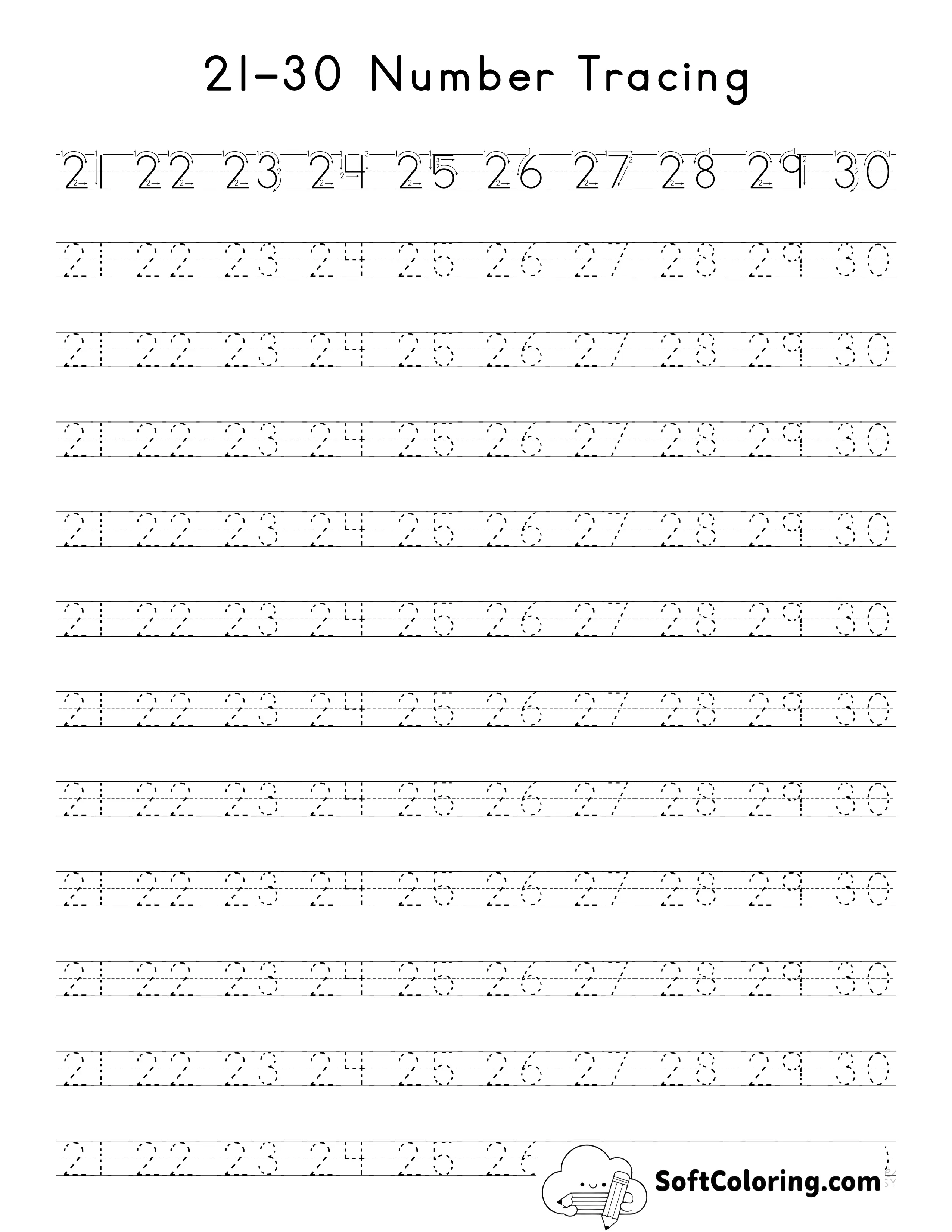
This specific set of printables focuses heavily on numeral formation and stroke order for the numbers twenty-one through thirty. Children often encounter unique challenges when moving beyond the tens place, particularly with reversal tendencies and the spatial orientation of placing two digits side by side correctly. The dotted formation guides on the page offer explicit starting points and directional arrows, reducing cognitive load while encouraging proper pencil habits. Through repeated exposure, learners internalize the distinct curves of the two, the straight-line precision of the one, and the sweeping loops of the three, zero, five, six, seven, eight, and nine. Exploring these numbers through dedicated Tracing Number exercises helps cement both math literacy and pencil control in one integrated session.
Key Learning Outcomes
Working consistently through these pages fosters precise visual-motor integration as little hands learn to anchor the paper with one hand while executing controlled strokes with the other. Children simultaneously reinforce number recognition and sequential counting from twenty-one to thirty, bridging early math concepts with physical literacy. Furthermore, the deliberate layout encourages proper spatial awareness, teaching learners how to keep multi-digit numbers aligned within designated writing bounds. According to the National Association for the Education of Young Children, active engagement with fine motor materials directly supports cognitive development and self-regulation during the early years. Ultimately, these practice sheets cultivate the hand endurance needed for longer writing tasks without inducing fatigue or frustration.
How to Use This Worksheet
Facilitating this practice effectively involves balancing independence with gentle, real-time guidance during pencil strokes. It helps to introduce the pages during calm, focused parts of the day when hand fatigue is at a minimum and attention spans are fresh. Adults can demonstrate the correct starting point for each numeral in the air or on a small chalkboard before letting the child touch the paper. Here’s what makes this resource different: the scaling of the dotted lines provides gradual fading, allowing children to move from heavily guided tracing to independent copying seamlessly. Pairing the writing practice with physical counting objects like counting bears or blocks reinforces the actual value behind the symbols being drawn on the page.
Practical Tips for Parents and Teachers
Observe the child’s grip closely, watching for a functional tripod grasp that allows fingers to move fluidly rather than locking into a rigid fist. Scaffolding the activity by having the child trace the numbers first with a finger, then a thick crayon, and finally a regular pencil builds sensory-rich pathways to the brain. Avoid overwhelming the learner by assigning the entire sequence at once; instead, focus on two or three numbers per session to maintain high engagement and neat execution. Celebrate small victories, such as a well-formed loop or staying closely aligned with the dotted path, to keep motivation strong. When additional practice is needed for foundational strokes, integrating resources from Fine Motor and Pre-Writing Skills can further strengthen hand muscles before tackling numbers again.
Age-Appropriate Recommendations
Aligning with the National Association for the Education of Young Children Developmentally Appropriate Practice, children aged four to six typically show readiness for guided numeral tracing as their hand dominance and pincer grasp solidify. Younger children around age three may benefit more from gross motor tracing and sensory exploration, while older kindergarten and first-grade students use these sheets to refine speed, consistency, and spatial alignment. Educators can easily adapt the expectations based on individual developmental tiers, offering larger writing spaces for younger learners and tighter line bounds for those ready for advanced precision. For broader skill reinforcement across different domains, exploring options within Alphabet And Numbers Tracing ensures a well-rounded pre-writing routine.
Foundational fine motor control and bilateral coordination are critical precursors to successful handwriting and numeral formation. — American Occupational Therapy Association
Frequently Asked Questions
Answers to common questions regarding downloading, printing, and utilizing these printable pages for early childhood education.
Explicit instruction in letter and numeral formation reduces reversal rates and builds automaticity in early elementary students. — International Dyslexia Association
Explore More Free Printable Tracing Worksheets
Supporting a child’s journey toward confident writing involves a rich variety of engaging, developmentally sound practice materials tailored to every stage of growth. Discover a comprehensive collection of resources designed to build hand strength, pencil control, and early literacy at KidTraces.com. Whether looking for seasonal motifs, structured pre-writing lines, or letter formation practice, every tool is crafted to make learning joyful and effective. Access the entire library to support continuous, skill-building fun at home or in the classroom today.
Developmental Milestone & Activity Table
| Development Stage | Recommended Daily Duration | Primary Learning Objective |
|---|---|---|
| Preschool & Pre-K | 10 – 15 Minutes | Pencil grip development & basic pre-stroke lines |
| Kindergarten | 15 – 20 Minutes | Letter/number formation & spatial line awareness |
| Early Elementary (Grade 1–2) | 20 – 30 Minutes | Fluency, sentence construction & neatness |
Images References