Introduction
Many young children recognize letters and symbols long before their fine motor skills can comfortably form them on paper. This common disconnect often leads to frustration during early writing attempts if the underlying hand strength and stroke control are overlooked. According to the American Occupational Therapy Association, foundational fine motor skills and controlled hand movements are essential precursors to functional handwriting and academic success. Bridging this gap requires targeted practice that builds muscle memory without demanding the immediate perfection of standard letter forms. The free printable line tracing curveworksheet serves as an indispensable tool in this developmental progression, offering structured practice for essential pre-writing strokes. It sounds simple, and that’s the point: mastering curves and directional lines lays the neurological groundwork for effortless pencil control.
💡 Educational Key Takeaways:
- Core Skill: Structured Line Tracing Curveworksheet focused on developing pencil grip, stroke control, and early literacy/math confidence.
- Target Scope: Suited for homeschoolers, preschool, kindergarten, and elementary learners.
- Best Recommendation: Practice 10–15 minutes daily with ergonomic writing tools to reinforce muscle memory without hand fatigue.
What This Worksheet Covers
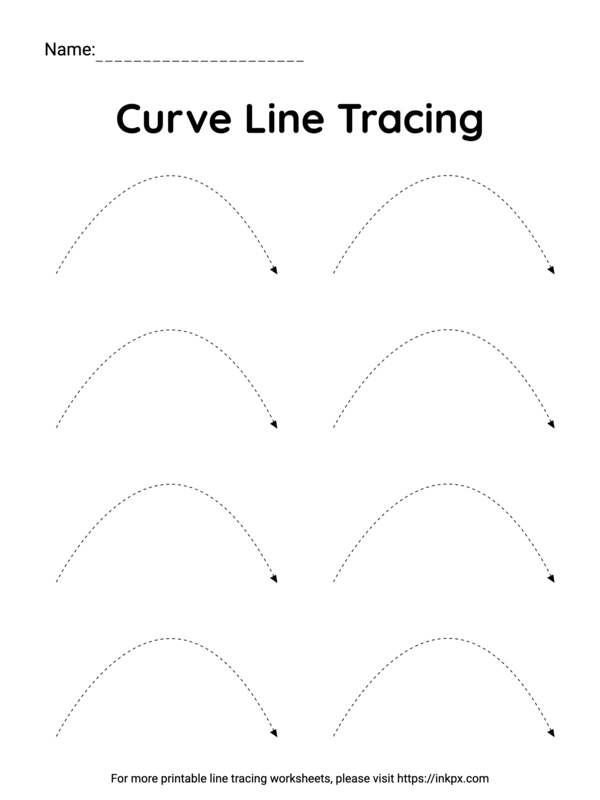
The line tracing curveworksheet focuses heavily on continuous curved paths, rolling hills, loops, and wavy wave patterns that mirror the foundational strokes required for lowercase cursive and print letters. Children encounter a series of visual pathways designed to guide the writing hand through smooth, continuous motions rather than choppy, segmented marks. Through repeated exposure to these arcs and bends, learners internalize the rhythmic flow necessary for fluid handwriting. It is fascinating to watch a child transition from heavy, erratic grips to light, sweeping movements as they navigate these curved tracks. Integrating resources from Shape and Line Tracing complements this practice by building visual-motor integration before children advance to more complex letter formations. Every curve on the page acts as a subtle physical workout for the intrinsic muscles of the hand, training the fingers to modulate pressure and direction simultaneously.
Key Learning Outcomes
Engaging consistently with curve-focused practice yields measurable improvements in multiple domains of early childhood development. Learners drastically enhance their pencil control by maintaining continuous contact between the writing tool and the paper along complex arcs. Hand-eye coordination strengthens significantly as eyes track ahead of the hand to anticipate upcoming turns and direction changes in the path. Spatial awareness improves naturally as children learn to contain their pencil strokes within specific visual boundaries without wandering off track. Finally, bilateral integration is reinforced because one hand actively stabilizes the paper while the dominant hand executes the precise tracing movements.
How to Use This Worksheet
Implementation requires a balance of structure and gentle guidance to keep young learners motivated and relaxed. Begin by presenting the worksheet on a flat, stable surface with appropriate seating that allows both feet to rest flat on the floor for maximum core stability. Encourage children to trace the lines using their index finger first, experiencing the physical motion kinesthetically before introducing a pencil or marker. According to the National Association for the Education of Young Children, active, hands-on engagement supports optimal cognitive and motor skill development in early childhood environments. Pairing this practice with selections from Fine Motor and Pre-Writing Skills ensures a comprehensive approach to hand strengthening that goes beyond paper tasks.
Practical Tips for Parents and Teachers
Adults play a vital role in shaping positive writing habits by observing grip and providing supportive scaffolding during practice sessions. Model an efficient tripod grasp without forcing rigid finger positions that cause hand fatigue in developing joints. Scaffold the activity by starting with thicker, shorter writing tools like short crayons or colored pencils, which naturally encourage a proper grasp compared to standard long pencils. Extend the learning by asking children to describe the shape of the lines out loud, using descriptive vocabulary like swoop, hill, or loop to connect auditory cues with visual motor patterns. Avoid rushing the completion of the page; slow, deliberate control yields far better neurological conditioning than hurried scribbling.
Age-Appropriate Recommendations
For children ages two to four, the focus under the CDC developmental milestones centers on imitating vertical and horizontal lines, making early curved paths an ideal next step for expanding stroke repertoires. Toddlers and preschoolers in this younger bracket benefit from large, bold curves that accommodate emerging visual-motor integration without demanding extreme precision. As children progress into the five-to-eight age range, expectations shift toward refined pencil control, smooth directional changes, and maintaining consistent line pressure across intricate tracing pathways. Educators can align these activities directly with handwriting curricula like Handwriting Without Tears, ensuring that the curved strokes practiced on the worksheet translate seamlessly into actual manuscript and cursive letter formation.
Foundational fine motor skills and controlled hand movements are essential precursors to functional handwriting and academic success — American Occupational Therapy Association
Frequently Asked Questions
Answers to common inquiries regarding downloading, printing, and utilizing tracing sheets effectively in homes and classrooms.
Explore More Free Printable Tracing Worksheets
Supporting a child’s early writing journey involves offering a wide variety of engaging, developmentally appropriate practice materials tailored to their unique interests and skill levels. Exploring the broader collection available across the site opens up endless opportunities for continuous learning and skill reinforcement. Browse the full library of resources by visiting KidTraces.com to discover additional alphabet sheets, seasonal activities, and targeted practice pages designed to inspire young learners every single day. Every printable asset is carefully crafted to build confidence, foster independence, and make the transition into formal writing an enjoyable adventure for children everywhere.
Developmental Milestone & Activity Table
| Development Stage | Recommended Daily Duration | Primary Learning Objective |
|---|---|---|
| Preschool & Pre-K | 10 – 15 Minutes | Pencil grip development & basic pre-stroke lines |
| Kindergarten | 15 – 20 Minutes | Letter/number formation & spatial line awareness |
| Early Elementary (Grade 1–2) | 20 – 30 Minutes | Fluency, sentence construction & neatness |
Images References