Introduction
Watch any group of preschoolers pick up a marker, and a profound developmental truth becomes immediately clear: many children recognize letters and shapes long before their fine motor control possesses the physical strength and dexterity to form them accurately on a blank page. According to the National Association for the Education of Young Children, young children learn best through active, hands-on experiences that bridge the gap between cognitive understanding and physical capability. Translating visual concepts into coordinated hand movements requires deliberate practice, patience, and the right developmental scaffolds. This is precisely where targeted printable resources step in to bridge the gap. Utilizing dotted shapes for tracing provides young learners with the gentle, structured guidance necessary to transform raw hand movements into controlled, intentional pre-writing strokes.
💡 Educational Key Takeaways:
- Core Skill: Structured Dotted Shapes For Tracing focused on developing pencil grip, stroke control, and early literacy/math confidence.
- Target Scope: Suited for homeschoolers, preschool, kindergarten, and elementary learners.
- Best Recommendation: Practice 10–15 minutes daily with ergonomic writing tools to reinforce muscle memory without hand fatigue.
What This Worksheet Covers
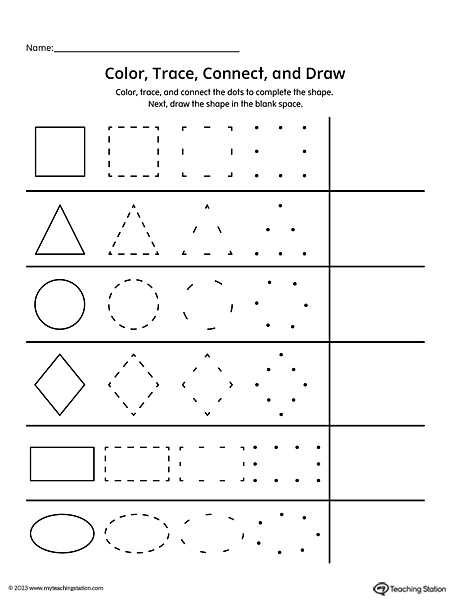
This specific printable focuses on fundamental geometric shapes outlined in precise, continuous dotted lines. Circles, squares, triangles, and rectangles populate the page, offering varying levels of visual-motor challenge. Beyond simply connecting dots, the layout encourages children to master directional flow, spatial awareness, and consistent pencil pressure. Every shape isolates a specific pre-writing stroke, whether it is the continuous curved rotation required for a circle or the sharp, controlled directional shifts needed to anchor the corners of a square. Working through these distinct patterns prepares hands for the intricate demands of letter and numeral formation found in broader Alphabet And Numbers Tracing curricula.
Key Learning Outcomes
Engaging with these geometric templates yields multiple foundational benefits across early childhood development. Pencil control improves as hands learn to slow down and follow a continuous trajectory rather than making haphazard marks across a page. Visual-motor integration strengthens significantly because the eyes must guide the hand in real-time response to visual feedback. Bilateral coordination also develops organically as one hand stabilizes the paper while the dominant hand executes the tracing motion. Furthermore, children build essential wrist stability and intrinsic hand muscle endurance, which serve as the physical prerequisites for long periods of writing without fatigue. For more related activities, check out our Square Trace For Toddlers.
How to Use This Worksheet
Success with pre-writing materials depends heavily on the initial setup and environmental approach. Placing the paper on a flat, stable surface helps maintain proper postural support, which directly influences hand function. Inviting children to first trace the dotted lines with an index finger provides crucial tactile and proprioceptive feedback before introducing a writing utensil. Once a pencil or crayon enters the equation, encouraging a functional grasp ensures that fingers remain flexible and capable of fluid movement. It sounds simple, and that is the point: keeping the initial introduction low-stress prevents hand cramping and anxiety around writing tasks.
Practical Tips for Parents and Teachers
Adult guidance can make or break the tracing experience for a developing child. Modeling the correct starting point and directional stroke order provides a clear visual blueprint for success. Scaffolding the activity by hand-over-hand assistance for the first repetition helps children feel the proper movement pattern without frustration. Extending the learning beyond the paper can also work wonders; children can trace the same shapes in sensory trays filled with sand or shaving cream to reinforce muscle memory. Varying the writing tools—swapping standard pencils for chunky crayons, colored pencils, or short pieces of broken chalk—naturally encourages a stronger, more functional tripod grasp by limiting excessive finger wrapping.
Age-Appropriate Recommendations
Developmental readiness dictates how children interact with tracing materials across different age brackets. For toddlers and preschoolers ages two through four, the focus centers on large, basic shapes like vertical lines, horizontal lines, and simple circles, aligning with the early stages of the Handwriting Without Tears developmental sequence. Children in this bracket benefit from thicker writing instruments and larger dotted pathways that accommodate developing motor control. As children reach ages five through eight, expectations shift toward precise corner control, closed geometric figures, and reduced reliance on heavy visual prompts. During these early elementary years, tracing activities support the complex fine motor demands outlined in national kindergarten and first-grade readiness frameworks.
Proficient fine motor control and visual-motor integration directly correlate with early academic success and reading readiness in young children. — American Occupational Therapy Association
Frequently Asked Questions
Clear guidance helps educators and families maximize the benefits of these foundational tracing tools.
How do I download and print these tracing worksheets?
Click the download link on the resource page to save the PDF file directly to a computer or mobile device, then send it to a home or classroom printer using standard letter-sized paper.
How does tracing support fine motor and pre-writing development?
Tracing builds intrinsic hand strength, improves pencil grip endurance, and enhances the visual-motor coordination required to form clean lines, curves, and letters.
What does the American Occupational Therapy Association say about fine motor practice?
The American Occupational Therapy Association emphasizes that targeted hand-strengthening and pre-writing activities are essential occupational tasks that prepare children for classroom writing, cutting, and self-care independence.
Explore More Free Printable Tracing Worksheets
Expanding a child’s collection of practice materials keeps engagement high and skill progression steady across every developmental milestone. Additional targeted exercises, including specialized Shape and Line Tracing pages, help solidify early control before moving on to complex Word and Name Tracing practice. Every child moves at an individual pace, and having access to a diverse array of foundational tools ensures that learning remains an enjoyable, pressure-free experience. Discover the complete library of teacher-approved resources by visiting KidTraces.com today.
Developmental Milestone & Activity Table
| Development Stage | Recommended Daily Duration | Primary Learning Objective |
|---|---|---|
| Preschool & Pre-K | 10 – 15 Minutes | Pencil grip development & basic pre-stroke lines |
| Kindergarten | 15 – 20 Minutes | Letter/number formation & spatial line awareness |
| Early Elementary (Grade 1–2) | 20 – 30 Minutes | Fluency, sentence construction & neatness |
Images References