Introduction
Watch any group of preschoolers hold a crayon, and the complex mechanics of early writing become immediately clear. Many children recognize letters and shapes long before their fine motor skills can actually form them on paper. According to the American Occupational Therapy Association, foundational fine motor control and bilateral coordination are essential prerequisites for functional handwriting and classroom success. Bridging that gap requires targeted practice that builds hand strength without causing frustration. Diamond line tracing provides a structured, engaging way to develop the precise directional shifts needed for advanced writing. It sounds simple, and that’s the point: mastering diagonal strokes unlocks the geometry of letters and shapes. Resources like the Shape and Line Tracing collection help transform these foundational hand movements into fun, accessible exercises for growing learners.
💡 Educational Key Takeaways:
- Core Skill: Structured Diamond Line Tracing focused on developing pencil grip, stroke control, and early literacy/math confidence.
- Target Scope: Suited for homeschoolers, preschool, kindergarten, and elementary learners.
- Best Recommendation: Practice 10–15 minutes daily with ergonomic writing tools to reinforce muscle memory without hand fatigue.
What This Worksheet Covers
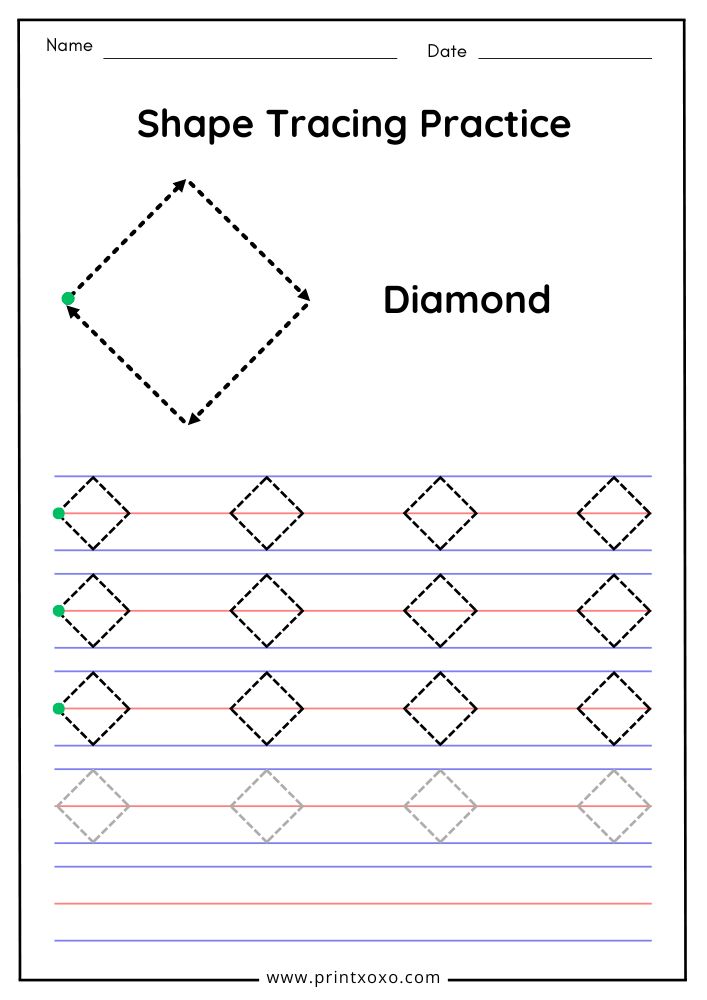
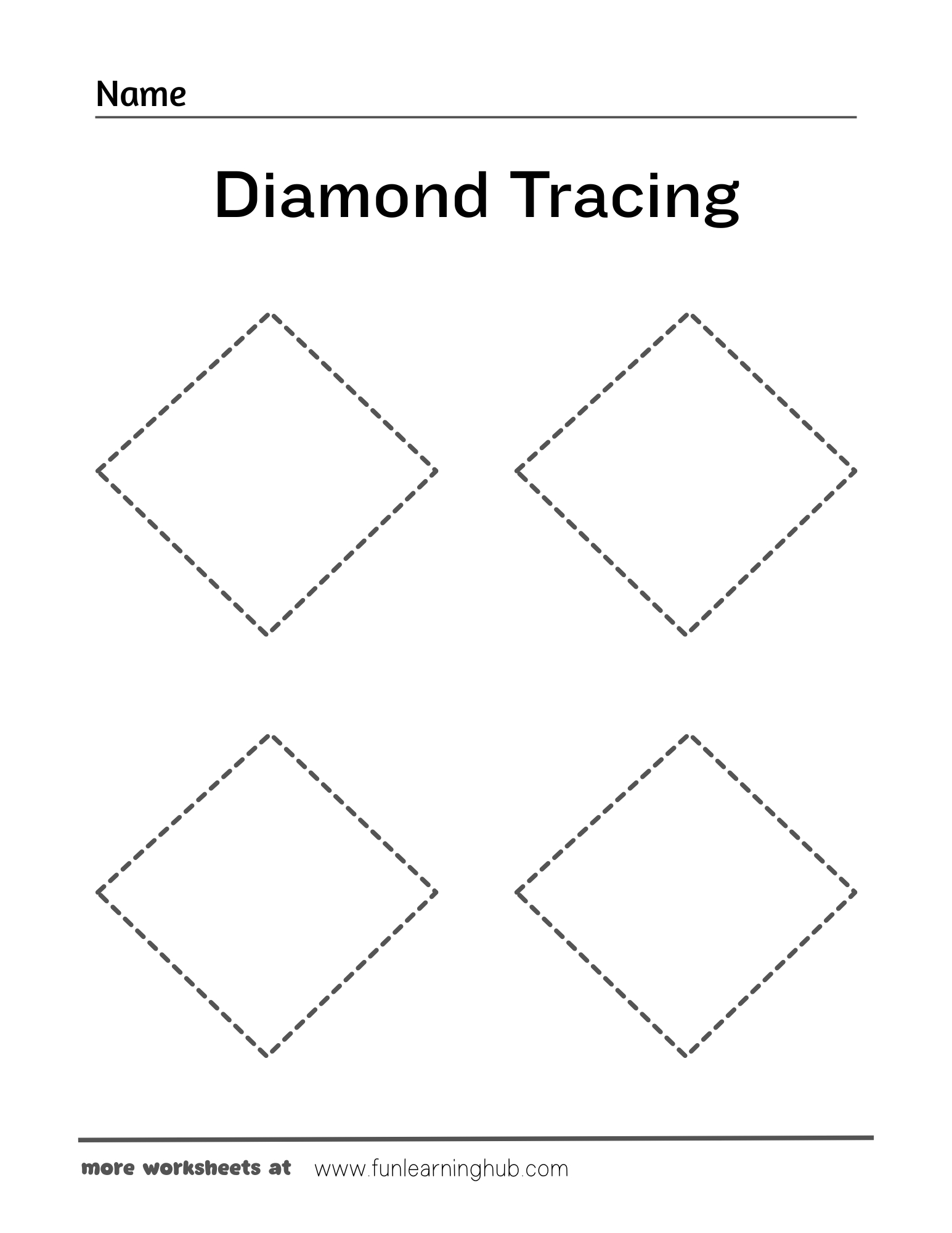
Geometrical shapes demand exceptional visual-motor integration because they require continuous redirection of the writing tool. The diamond shape specifically challenges the visual perception system with its slanted lines and sharp vertex angles. Instead of relying purely on vertical and horizontal motions, learners must guide a pencil upward, change direction at the top corner, slide downward, and repeat the process symmetrically. This sheet targets the oblique strokes that often prove troublesome during early literacy instruction. Many educators observe that children easily master squares and circles long before mastering diamonds, triangles, or angled letters like ‘A’, ‘K’, and ‘V’. Working through these specific configurations strengthens the intrinsic hand muscles required for a mature pencil grasp.
Key Learning Outcomes
Targeted pencil control improves dramatically as children repeatedly trace the diagonal paths of a diamond. Visual-spatial awareness expands because learners must judge distances and anticipate directional changes before reaching the corners. Hand-eye coordination strengthens significantly through the continuous visual monitoring required to stay on the dotted path. Crossing the midline becomes natural as the hand moves smoothly across the page from left to right and back again. Furthermore, bilateral integration develops as the stabilizing hand holds the paper firmly while the dominant hand executes the precise tracing movements.
How to Use This Worksheet
Preparation and environment dictate the success of any fine motor activity. Begin by placing the worksheet on a flat, stable surface where the feet rest comfortably on the floor or a footrest to provide proximal stability. Encourage the child to start tracing from the designated visual cue, usually marked with a clear starting dot at the top vertex. Allow plenty of time for the child to pause at the corners, as these directional shifts require intentional deceleration and control. It helps to integrate multi-sensory elements, such as tracing the large outer lines with a finger before introducing a pencil or crayon. To expand fine motor foundations further, explore the wider range of activities found within the Fine Motor and Pre-Writing Skills category.
Practical Tips for Parents and Teachers
Pencil grip matters immensely, so check frequently for a functional grasp that allows finger mobility rather than a tight, closed fist. Scaffold the experience by gently guiding the hand through the first few strokes if the child demonstrates hesitation or muscle fatigue. Avoid erasing mistakes immediately; instead, discuss why the pencil strayed and how to adjust the hand pressure on the next attempt. Extend the learning by having the child trace smaller versions or transition to independent drawing after mastering the guided lines. For additional practice with linear control and stroke sequencing, incorporating selections from the Alphabet And Numbers Tracing library offers a seamless next step.
Age-Appropriate Recommendations
Developmental readiness dictates how children interact with geometric tracing activities. According to the National Association for the Education of Young Children guidelines for developmentally appropriate practice, children aged two to four typically engage with pre-writing strokes through large-motor movements and thick writing utensils. During these early years, focus primarily on gross motor lines, vertical strokes, and simple circles rather than precise diamond shapes. For children aged five to eight, the focus shifts toward refining pencil control, mastering acute angles, and aligning with school readiness standards. At this stage, complex shapes like diamonds reinforce the exact oblique lines needed for uppercase letter formation and mathematical geometry.
Proficiency in visual-motor integration and oblique line copying strongly predicts early academic performance and handwriting legibility in primary school. — National Association for the Education of Young Children (NAEYC)
Frequently Asked Questions
More than 70 percent of a young child’s school day involves fine motor or writing tasks, highlighting the vital need for early stroke mastery. — American Occupational Therapy Association (AOTA)
Explore More Free Printable Tracing Worksheets
Supporting a child’s writing journey involves offering a wide variety of engaging, developmentally appropriate practice materials. Whether the daily focus centers on letters, numbers, or creative patterns, keeping practice fresh maintains high motivation. The full library of resources at KidTraces.com provides endless opportunities for growth. Discover themed options and structured practice sheets by visiting the Seasonal and Fun Themes section for year-round learning inspiration.
Developmental Milestone & Activity Table
| Development Stage | Recommended Daily Duration | Primary Learning Objective |
|---|---|---|
| Preschool & Pre-K | 10 – 15 Minutes | Pencil grip development & basic pre-stroke lines |
| Kindergarten | 15 – 20 Minutes | Letter/number formation & spatial line awareness |
| Early Elementary (Grade 1–2) | 20 – 30 Minutes | Fluency, sentence construction & neatness |
Images References