Introduction
Many children recognize shapes, letters, and numbers long before their fine motor coordination allows them to accurately replicate those forms on paper. According to the American Occupational Therapy Association, foundational hand strength and visual-motor integration must be adequately developed before children can consistently execute controlled pencil strokes. Witnessing a child struggle to close the lines of a geometric figure highlights a common developmental gap between cognitive understanding and physical execution. Mastery doesn’t happen overnight, but targeted tools bridge that exact gap. Enter the diamond worksheet, a deceptively simple resource designed to transform frustration into fluid pencil control. By isolating the specific angles and line junctions required to form a diamond, this printable guides young hands through crucial pre-writing strokes without overwhelming the learner. It sounds simple, and that’s the point.
💡 Educational Key Takeaways:
- Core Skill: Structured Diamond Worksheet focused on developing pencil grip, stroke control, and early literacy/math confidence.
- Target Scope: Suited for homeschoolers, preschool, kindergarten, and elementary learners.
- Best Recommendation: Practice 10–15 minutes daily with ergonomic writing tools to reinforce muscle memory without hand fatigue.
What This Worksheet Covers
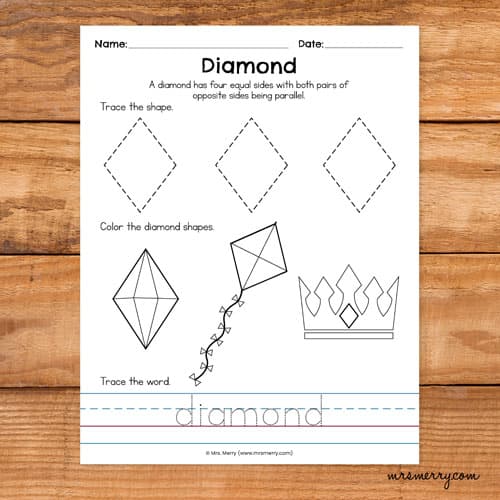
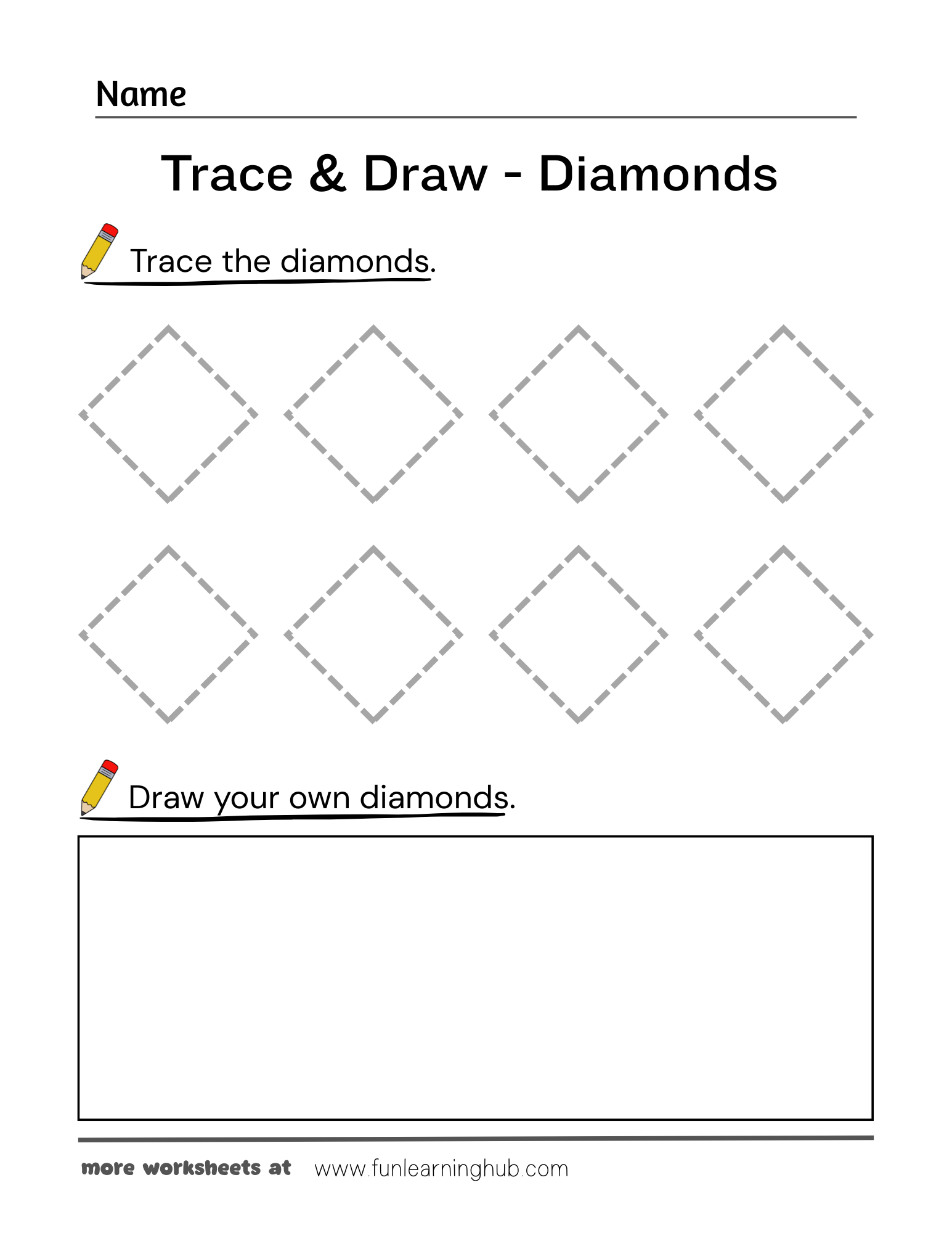
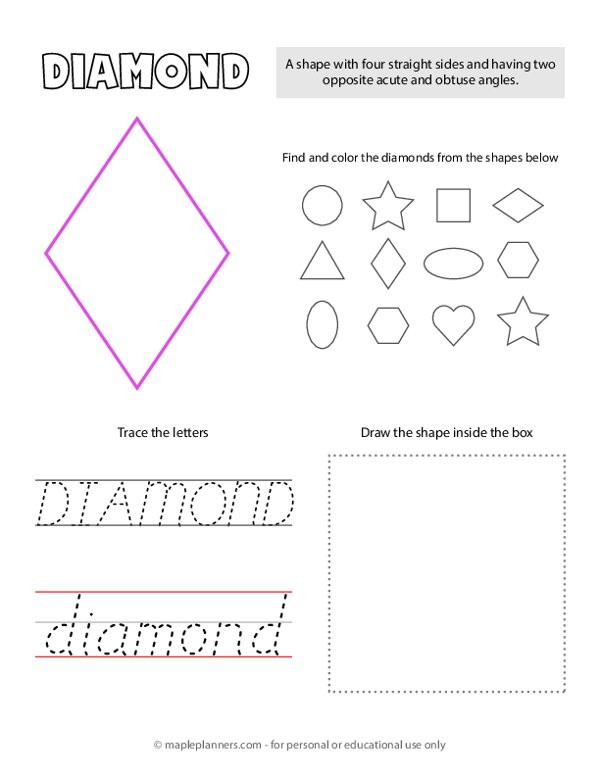
Tracing a diamond requires a unique combination of diagonal lines, sharp directional changes, and precise stopping points that vertical and horizontal lines simply do not demand. This particular worksheet focuses heavily on continuous stroke planning, visual tracking, and spatial orientation. Unlike basic circles or squares, a diamond introduces oblique angles which challenge the intrinsic muscles of the hand and require bilateral coordination. As learners guide their pencils from the top apex down to the left and right corners, they practice modulating pressure and slowing down at critical vertex points. The layout provides ample scaffolding, moving from heavily dotted guidelines to sparser tracing prompts that encourage independent hand movement. Children transition from passive tracing to active motor planning, establishing pathways in the brain that support future geometry and handwriting success.
Key Learning Outcomes
Working through the diamond worksheet systematically builds several interconnected developmental domains essential for early childhood success. First, learners refine visual-motor integration by visually mapping the diagonal trajectory before the hand executes the movement. Second, the exercise strengthens finger dexterity and grip stability, which directly aligns with foundational concepts found in Fine Motor and Pre-Writing Skills. Third, children develop directional awareness, learning how to shift pencil momentum smoothly through sharp corners without lifting the writing utensil. Fourth, sustained engagement with these geometric forms fosters frustration tolerance and perseverance, transforming complex visual challenges into achievable physical tasks.
How to Use This Worksheet
Success with pre-writing materials depends heavily on the physical setup and the immediate environment provided to the learner. Placing the worksheet on a flat, well-lit surface helps maintain proper posture, while a slanted writing board can naturally encourage an upright wrist position and an efficient grasp. Adults should encourage children to anchor their non-working hand on the paper to stabilize the page, a strategy that prevents slipping and promotes bilateral integration. Rather than rushing through multiple pages in one sitting, limit practice sessions to short, five-minute intervals to prevent hand fatigue and maintain high engagement. Celebrating small victories, such as a smoothly rounded corner or a sharp bottom vertex, reinforces confidence and keeps the learning experience entirely positive.
Practical Tips for Parents and Teachers
Adults play a vital role in scaffolding the tracing process by modeling correct posture and pencil grip before handing over the writing tool. If a child demonstrates a heavy, white-knuckled fist grasp, gently encourage a tripod grasp using smaller crayons or broken chalk pieces to naturally force finger isolation. Scaffolding can also involve tactile exploration, allowing the child to trace a large textured diamond with an index finger before picking up a pencil. When learners show fatigue, transition to a kinesthetic game by having them draw giant diamonds in the air using straight, deliberate arm movements. For additional structural practice with various geometric forms, incorporating resources from Shape and Line Tracing provides a wonderful continuum of difficulty.
Age-Appropriate Expectations
Developmental readiness dictates how children interact with geometric tracing tasks, and expectations should align with established milestones. According to the Centers for Disease Control and Prevention developmental milestones, most children around age four begin to copy cross shapes and imitate basic geometric designs, while diagonal lines typically emerge closer to kindergarten age. For younger children aged two to four, the focus should remain on gross motor arm movements, finger isolation, and simple sensory tracing. Conversely, children aged five to eight can refine these skills under the National Association for the Education of Young Children Developmentally Appropriate Practice guidelines, focusing on precision, controlled pencil pressure, and accurate closure of complex shapes like diamonds. Exploring broader collections such as Tracing Worksheets ensures educators can always find materials matching a child’s exact developmental stage.
Diagonal line imitation and complex shape copying typically emerge between ages four and five — Centers for Disease Control and Prevention
Frequently Asked Questions
Navigating early childhood writing tools can raise numerous practical questions for educators and caregivers alike. Below are clear, direct answers addressing printing best practices, fine motor benefits, and expert developmental guidance for the diamond worksheet.
Explore More Free Printable Tracing Worksheets
Supporting a child’s journey toward fluent handwriting and strong fine motor control requires a rich variety of engaging, accessible resources. Every learner progresses at an individual pace, and having access to a diverse library ensures practice never becomes monotonous or frustrating. Parents, teachers, and homeschoolers are warmly invited to explore the entire collection of free resources available across KidTraces.com to find everything needed for daily pencil control practice.
Developmental Milestone & Activity Table
| Development Stage | Recommended Daily Duration | Primary Learning Objective |
|---|---|---|
| Preschool & Pre-K | 10 – 15 Minutes | Pencil grip development & basic pre-stroke lines |
| Kindergarten | 15 – 20 Minutes | Letter/number formation & spatial line awareness |
| Early Elementary (Grade 1–2) | 20 – 30 Minutes | Fluency, sentence construction & neatness |
Images References