Introduction
Watch any three-year-old attempt to draw a box, and the results usually reveal a delightful collection of loops, stray curves, and wandering zigzags long before a true corner ever appears. According to the Centers for Disease Control and Prevention milestones, typical three-year-old children are just beginning to master copying simple shapes like circles and horizontal lines, making structured early geometry a fascinating challenge for small hands. Introducing worksheets on shape square for small kids of 3 years old bridges the exciting gap between freeform scribbling and purposeful pencil control. It sounds simple, and that’s the point. Young learners thrive when foundational concepts are broken down into manageable, visually engaging strokes that build spatial awareness. Many adults mistakenly believe that geometric tracing is purely an academic math exercise, but occupational therapists view it as an essential pre-writing diagnostic tool. Straight lines and ninety-degree angles require a unique combination of visual-motor integration, bilateral coordination, and sustained postural stability that prepares the hand for future letter formation. Through targeted practice with a square template, children begin to understand boundaries, directional changes, and the concept of closing a shape.
💡 Educational Key Takeaways:
- Core Skill: Structured Worksheets On Shape Square For Small Kids Of 3 Years Old focused on developing pencil grip, stroke control, and early literacy/math confidence.
- Target Scope: Suited for homeschoolers, preschool, kindergarten, and elementary learners.
- Best Recommendation: Practice 10–15 minutes daily with ergonomic writing tools to reinforce muscle memory without hand fatigue.
What This Worksheet Covers
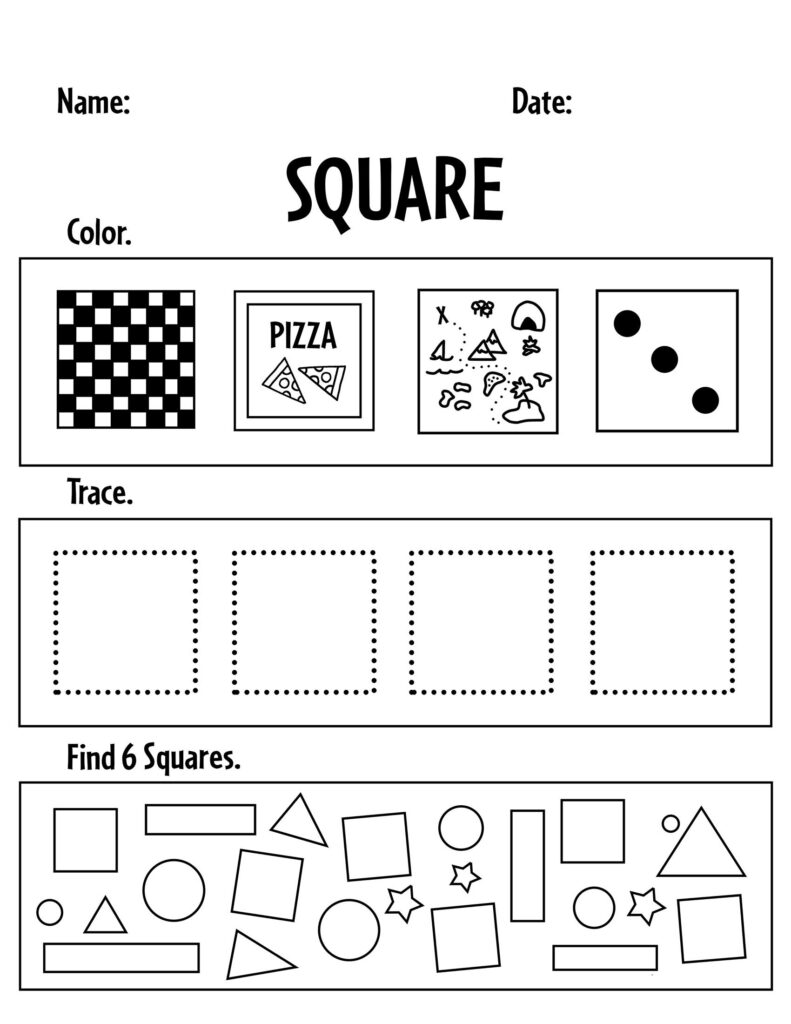
The primary focus centers on guiding small fingers and clumsy grips along distinct linear paths that mimic the four equal sides of a square. Visual cues, directional arrows, and bold dotted lines work together to show the hand precisely where to start, where to pause, and how to pivot cleanly. This careful design supports foundational Shape and Line Tracing abilities by introducing the concept of corners and directional shifts. Children often recognize shapes in their environment long before their hand muscles possess the endurance to replicate them smoothly on paper. This resource honors that developmental gap by offering gentle visual scaffolding rather than rigid testing. Every stroke encourages the brain to map out horizontal and vertical trajectories, which directly feeds into the broader continuum of Fine Motor and Pre-Writing Skills. As learners trace from top to bottom and left to right, they unconsciously internalize the exact visual scanning patterns required later for reading and writing standard alphabet characters.
Key Learning Outcomes
Working through these geometry pages fosters several interconnected developmental milestones all at once. Children refine their hand-eye coordination as they visually track the pencil tip while simultaneously adjusting their grip pressure to keep the line steady. Spatial awareness expands significantly as little ones learn to navigate inside a defined boundary, recognizing the distinct difference between open spaces and closed figures. Muscle memory develops in the tiny intrinsic muscles of the hand, which must learn to halt momentum, change direction sharply, and start a brand-new stroke down a fresh axis. Furthermore, completing a multi-step shape fosters early cognitive persistence, turning a frustrating physical task into a deeply satisfying accomplishment. This progression lays robust groundwork for transitioning into more structured Tracing Worksheets as confidence and stamina continue to grow naturally over time.
How to Use This Worksheet
Success with toddlers relies heavily on keeping the environment low-stress, highly engaging, and entirely pressure-free. Tape the printed sheet securely to the table surface using low-tack painter’s tape to prevent frustrating sliding movements that often derail a three-year-old’s focus. Offer thick, short writing instruments like broken crayons, golf pencils, or specialized triangle grips to naturally encourage a functional grasp without nagging. According to the American Occupational Therapy Association, providing short, playful bursts of fine motor play yields better engagement than long, forced practice sessions. Adults can make the experience multi-sensory by having children trace the square outline with a finger in the air or through a tray of sand before ever touching a writing tool to the paper. Whenever a corner approaches, exaggerate the pause verbally by saying stop, pivot, and turn, helping the child connect oral cues with physical hand movements.
Practical Tips for Parents and Teachers
Scaffolding the activity makes a tremendous difference for children who become easily overwhelmed by blank spaces or complex lines. Start by guiding the child’s hand gently through the first few strokes to let them feel the physical rhythm of the square before expecting independent execution. If standard crayons prove too frustrating, substitute them with thick paintbrushes dipped in water on a chalkboard to eliminate the friction of paper entirely. Always celebrate the process of trying rather than the perfection of the final product, remembering that a wiggly, rounded square represents monumental neural and muscular effort for a toddler. When attention spans begin to wane, stop immediately and save the rest for another day, keeping the positive association with writing entirely intact. Exploring alternative formats like General Kidtraces collections can also help maintain high motivation when variety is needed.
Age-Appropriate Recommendations
For children around age three, alignment with the National Association for the Education of Young Children Developmentally Appropriate Practice guidelines emphasizes playful, hands-on exploration over rote academic drill. At this stage, expecting crisp, mathematically perfect 90-degree angles is entirely unrealistic; rounded corners and wavy lines are normal markers of developing motor control. By age four and five, children transition from rough approximations to intentional corner-turning as their hand arches mature and visual-motor integration solidifies. Educators and caregivers should always meet each child at their current developmental threshold, offering thicker tracing paths for younger toddlers and thinner, more refined dotted lines as they approach kindergarten readiness. Matching expectations to biological capability ensures that early writing experiences remain joyful, confidence-building adventures rather than tedious chores.
According to the Centers for Disease Control and Prevention milestones, typical three-year-old children are just beginning to master copying simple shapes like circles and horizontal lines, making structured early geometry a fascinating challenge for small hands. — Centers for Disease Control and Prevention
Frequently Asked Questions
Explore More Free Printable Tracing Worksheets
Supporting a young child’s journey toward writing independence requires a diverse toolkit of engaging, developmentally sound resources. Beyond geometric shape practice, exploring different types of line control and early stroke patterns helps maintain enthusiasm day after day. Caregivers and educators are warmly invited to browse the entire collection of free resources available at KidTraces.com to find endless inspiration for fostering confident little hands.
Developmental Milestone & Activity Table
| Development Stage | Recommended Daily Duration | Primary Learning Objective |
|---|---|---|
| Preschool & Pre-K | 10 – 15 Minutes | Pencil grip development & basic pre-stroke lines |
| Kindergarten | 15 – 20 Minutes | Letter/number formation & spatial line awareness |
| Early Elementary (Grade 1–2) | 20 – 30 Minutes | Fluency, sentence construction & neatness |
Images References


