Introduction
Many children recognize letters, shapes, and numbers long before their fine motor skills can physically form them on paper. This common disconnect often frustrates eager learners who possess rich mental vocabularies yet lack the hand strength required for sustained pencil control. According to Reading Rockets, early writing development begins with mastering fundamental pre-writing strokes long before children ever attempt formal letter formation. Building that crucial foundation requires intentional, developmentally appropriate practice that targets hand-eye coordination and muscle memory. The single curved line tracing printable directly addresses this developmental milestone by offering targeted practice in fluid motion. It sounds simple, and that is the exact point. Reducing visual clutter allows young learners to focus entirely on the physical sensation of moving a writing utensil in a smooth, continuous arc. Through repeated engagement with structured Shape and Line Tracing activities, children bridge the gap between cognitive understanding and physical execution.
💡 Educational Key Takeaways:
- Core Skill: Structured Single Curved Line Tracing focused on developing pencil grip, stroke control, and early literacy/math confidence.
- Target Scope: Suited for homeschoolers, preschool, kindergarten, and elementary learners.
- Best Recommendation: Practice 10–15 minutes daily with ergonomic writing tools to reinforce muscle memory without hand fatigue.
What This Worksheet Covers
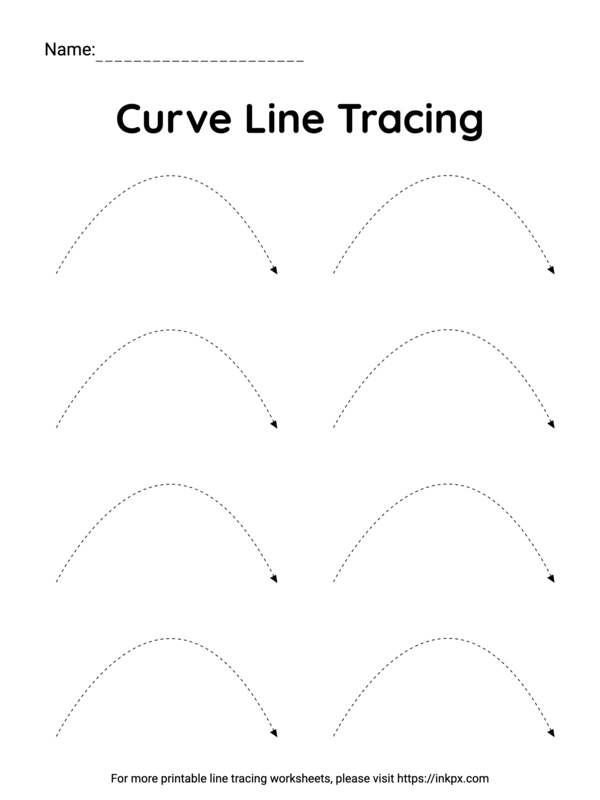
The single curved line tracing page focuses exclusively on mastering the foundational arc, a stroke that underpins nearly every curved letter in the alphabet, including lowercase c, s, e, and o. Rather than overwhelming developing hands with complex geometric shapes or dense mazes, this layout provides clear, welcoming visual pathways that gently guide the writing instrument from a distinct starting point to a clear endpoint. Children navigate sweeping rainbows, gentle hills, and smiling crescent shapes designed to mimic natural hand movements. Working through these distinct pathways strengthens the small intrinsic muscles of the hand while simultaneously teaching visual tracking, spatial awareness, and directional flow from left to right. It represents an essential step forward within broader Fine Motor and Pre-Writing Skills progressions, moving beyond basic vertical lines into more complex biomechanical motions.
Key Learning Outcomes
Engaging with this printable helps children refine several interconnected developmental domains simultaneously. First, the activity enhances pencil grip stability and finger dexterity as tiny hands learn to regulate downward pressure and speed along an arc. Second, it develops visual-motor integration, teaching the brain to translate visual cues into precise physical hand movements in real time. Third, tracing curved trajectories fosters bilateral coordination, as one hand stabilizes the paper while the dominant hand executes the smooth, flowing stroke. Finally, completing these pathways instills vital frustration tolerance and task persistence, transforming abstract motor planning into a tangible, satisfying accomplishment. These foundational gains ultimately prepare learners to transition smoothly into structured Dotted Letters For Tracing when they show signs of physical readiness.
How to Use This Worksheet
Maximizing the benefits of this resource requires a flexible, pressure-free approach that prioritizes engagement over perfection. Begin by presenting the printable on a flat, stable surface, ensuring the child’s chair and table promote an upright posture with feet flat on the floor for optimal core stability. Encourage tactile exploration before putting pencil to paper by having the child trace the curved lines with an index finger or a toy car. Transitioning to writing instruments works best when using short, thick crayons, triangular pencils, or broken pieces of chalk, as these natural modifications encourage an efficient tripod grasp. Adults can gently guide a hand from underneath for the first few repetitions, gradually fading support until the child navigates the curve independently. Integrating this page alongside thematic Seasonal and Fun Themes keeps enthusiasm high during daily practice sessions.
Practical Tips for Parents and Teachers
Every child progresses through pre-writing milestones at an entirely unique pace, making individualized scaffolding essential for sustained growth. If a child struggles to maintain contact with the line, try placing a heavy-textured tray beneath the paper or using high-contrast markers to increase visual feedback. Scaffold the experience by treating the curve as a storytelling journey, encouraging the pencil to slide gently down a hill or glide across a rainbow. Avoid correcting every stray mark, because fluid movement matters far more than staying strictly inside the tracks during early exploratory phases. Extend the learning naturally by inviting children to draw their own curved paths in shaving cream, sandbox trays, or finger paint before returning to paper. Exploring broader foundational exercises found within Alphabet And Numbers Tracing collections can further reinforce these foundational stroke patterns.
Age-Appropriate Recommendations
Developmental expectations for tracing vary significantly depending on age, aligning closely with established milestones outlined in the NAEYC Developmentally Appropriate Practice framework. For toddlers and young preschoolers aged two to four, the primary focus centers on sensory exploration, gross arm movements, and palmar or digital grasps, making finger-tracing and thick crayon use ideal. By the time children reach older preschool and kindergarten ages five through eight, fine motor endurance improves significantly, allowing for refined pencil control, precise wrist movement, and mastery of independent stroke directionality. Recognizing these distinct developmental windows prevents premature frustration and ensures children receive the exact type of physical support they need to thrive. Adults should always observe physical fatigue signs, keeping sessions brief and positive to protect delicate hand muscles from strain.
According to the American Occupational Therapy Association, early fine motor milestones are foundational precursors that directly influence handwriting legibility and academic success in later school years. — AOTA
Frequently Asked Questions
How do single curved line tracing sheets support early writing development? Tracing curved lines builds the exact muscle memory, hand strength, and visual-motor coordination required to form letters like c, s, and o fluidly. What is the easiest way to download and print these worksheets? Simply click the download button on the resource page, save the PDF file to a device, and print directly onto standard letter paper. According to the National Association for the Education of Young Children, play-based and hands-on fine motor practice is essential for building healthy neural pathways in early childhood.
Explore More Free Printable Tracing Worksheets
Supporting a child’s journey toward confident handwriting involves exploring a wide variety of engaging, developmentally tailored practice materials. Expanding beyond single curves opens up exciting new avenues for pencil control, shape recognition, and early literacy development across different seasons and learning goals. Discover the complete collection of learning resources available to parents, educators, and homeschoolers across the full library at KidTraces.com. Every printable is designed with care to ensure learning remains joyful, accessible, and deeply supportive of every unique child’s individual developmental timeline.
Developmental Milestone & Activity Table
| Development Stage | Recommended Daily Duration | Primary Learning Objective |
|---|---|---|
| Preschool & Pre-K | 10 – 15 Minutes | Pencil grip development & basic pre-stroke lines |
| Kindergarten | 15 – 20 Minutes | Letter/number formation & spatial line awareness |
| Early Elementary (Grade 1–2) | 20 – 30 Minutes | Fluency, sentence construction & neatness |
Images References