Introduction
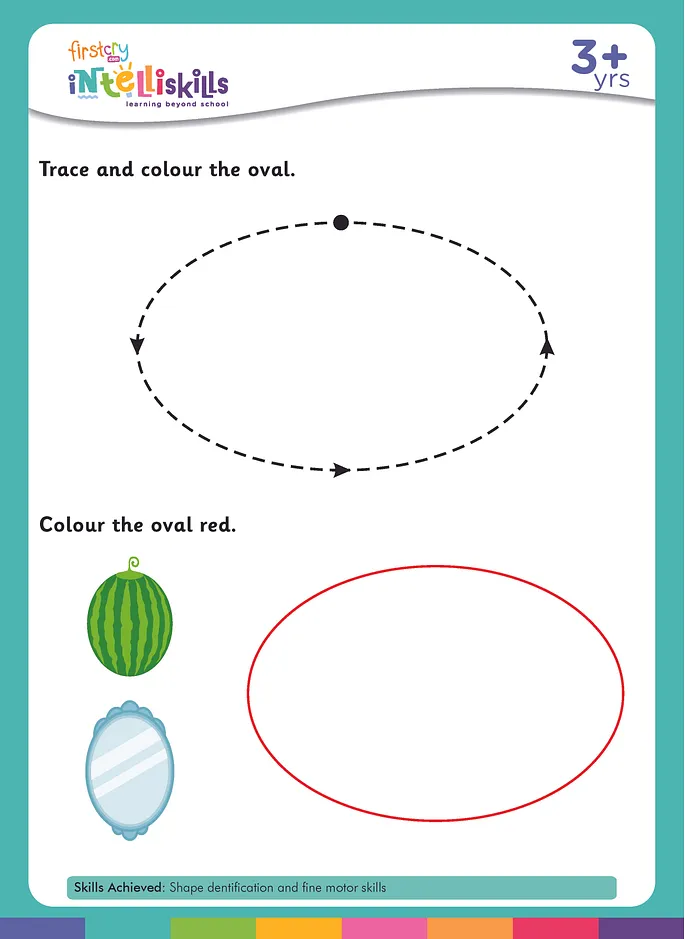
Many children recognize complex visual symbols long before their fine motor coordination allows them to accurately reproduce them on paper. According to the American Occupational Therapy Association, foundational fine motor control and bilateral hand integration are essential precursors to mastering academic tasks like handwriting and drawing. Many adults rush straight into letter formation, bypassing the crucial geometric foundations that hands need to build endurance and coordination. Children often struggle with writing because they skip the curve control that prepares fingers for fluid motion. The free printable tracing shape of oval targets these precise rotational movements. It sounds simple, and that’s the point. Mastering continuous curves builds the exact motor memory required for letters like ‘a’, ‘c’, and ‘o’.
💡 Educational Key Takeaways:
- Core Skill: Structured Tracing Shape Of Oval focused on developing pencil grip, stroke control, and early literacy/math confidence.
- Target Scope: Suited for homeschoolers, preschool, kindergarten, and elementary learners.
- Best Recommendation: Practice 10–15 minutes daily with ergonomic writing tools to reinforce muscle memory without hand fatigue.
What This Worksheet Covers
Smooth, continuous curved lines form the basis of this specialized tracing asset. Unlike straight lines or sharp angles, an oval requires continuous adjustment of hand pressure and direction, engaging both the radial and ulnar sides of the hand. Young learners practice maintaining constant visual-motor contact as pencils glide around the rounded perimeter. The layout provides ample white space and clear visual guides to minimize distraction and maximize focus on stroke fluidity. Exploration of the tracing shape of oval bridges the gap between random scribbling and controlled pre-writing strokes. It requires bilateral coordination, where one hand stabilizes the paper while the other executes the curved motion. Through repeated practice, children develop spatial awareness and hand-eye coordination that extends far beyond geometry. For more related activities, check out our Shapes – Oval And Dimond Worksheet For Kindergarten.
Key Learning Outcomes
Learners build foundational skills across several developmental domains while engaging with this material. Continuous curve control improves wrist stability and dynamic finger movements, which directly enhances stamina during extended writing tasks. Visual-motor integration strengthens as eyes track ahead of the hand to anticipate the curve’s trajectory. Directional consistency is established by practicing counter-clockwise movements, aligning with standard handwriting mechanics. Hand strength increases gradually through sustained pencil pressure management without hand fatigue. Spatial boundaries become clearer as children learn to keep their pencils within defined visual paths, supporting overall academic readiness.
How to Use This Worksheet
Preparation involves setting up an environment that supports optimal posture and ergonomic tool positioning. Flat surfaces at elbow height encourage feet to rest flat on the floor, providing proximal stability for distal hand control. Adults can introduce the page by demonstrating slow, deliberate finger movements in the air before touching the writing utensil to the paper. Tracing with a finger first gives proprioceptive feedback to the brain, mapping out the physical journey of the curve. It helps to observe the child’s grasp, gently encouraging an open web space and a functional tripoding or quadrupod grip. Consistency matters more than volume, meaning brief, daily sessions yield better muscle memory than long, exhausting drills.
Practical Tips for Parents and Teachers
Adults play a vital scaffolding role during early writing experiences by monitoring hand fatigue and maintaining low-pressure engagement. Modeling proper pencil grip explicitly before the session begins helps establish healthy biomechanical habits early on. Scaffolding the activity down involves starting with larger air-tracing or tactile sand trays before moving to paper. Extending the challenge means asking children to trace the oval using alternative tools like paintbrushes, cotton swabs, or dry-erase markers inside protective sleeves. Patience remains a critical asset, as smooth curved lines demand higher levels of neural integration than straight lines and take time to master consistently.
Age-Appropriate Recommendations
According to the National Association for the Education of Young Children guidelines on developmentally appropriate practice, children aged two to four benefit most from large-scale motor activities, chunky writing tools, and introductory curved line exposure. At this stage, focusing on gross motor and proximal shoulder stability prepares small hand muscles for intricate tasks later. Children aged five to eight refine these capabilities into precise pencil control, mastering smaller geometric shapes and letter formations in alignment with foundational handwriting curricula such as Handwriting Without Tears. This specific geometric tracing supports kindergarten readiness by bridging the gap between freeform art and controlled symbolic representation.
Foundational fine motor control and bilateral hand integration are essential precursors to mastering academic tasks like handwriting. — American Occupational Therapy Association (AOTA)
Frequently Asked Questions
Clear answers regarding implementation help caregivers maximize the developmental benefits of pre-writing practice.
Explore More Free Printable Tracing Worksheets
Expanding a child’s pre-writing repertoire involves exploring diverse foundational strokes and patterns across various developmental domains. Discover additional resources tailored to early childhood educators, parents, and homeschoolers by browsing the comprehensive collection at KidTraces.com. Whether focusing on foundational Shape and Line Tracing, developing fundamental dexterity through Fine Motor and Pre-Writing Skills, or diving into early literacy with Dotted Letters For Tracing, every educator can find tools to support every stage of growth. Explore the complete library of Tracing Worksheets to support holistic childhood development today.
Developmental Milestone & Activity Table
| Development Stage | Recommended Daily Duration | Primary Learning Objective |
|---|---|---|
| Preschool & Pre-K | 10 – 15 Minutes | Pencil grip development & basic pre-stroke lines |
| Kindergarten | 15 – 20 Minutes | Letter/number formation & spatial line awareness |
| Early Elementary (Grade 1–2) | 20 – 30 Minutes | Fluency, sentence construction & neatness |
Images References