Introduction
Many children recognize letters, numbers, and basic geometric forms long before their developing hand muscles possess the endurance required to cleanly form them on paper. According to the American Occupational Therapy Association, foundational fine motor control and visual-motor integration develop progressively through purposeful manipulation of tools and structured drawing experiences. Bridging this gap between cognitive awareness and physical execution requires intentional, low-stress practice. Shape pentagon worksheets for toddlers provide a targeted avenue for young learners to encounter geometric structures while simultaneously building crucial pencil control. It sounds simple, and that is the exact point. Geometric tracing offers an accessible bridge into early writing readiness by focusing on directional control, angled strokes, and continuous line paths.
💡 Educational Key Takeaways:
- Core Skill: Structured Shape Pentagon Worksheets For Toddlers focused on developing pencil grip, stroke control, and early literacy/math confidence.
- Target Scope: Suited for homeschoolers, preschool, kindergarten, and elementary learners.
- Best Recommendation: Practice 10–15 minutes daily with ergonomic writing tools to reinforce muscle memory without hand fatigue.
What This Worksheet Covers
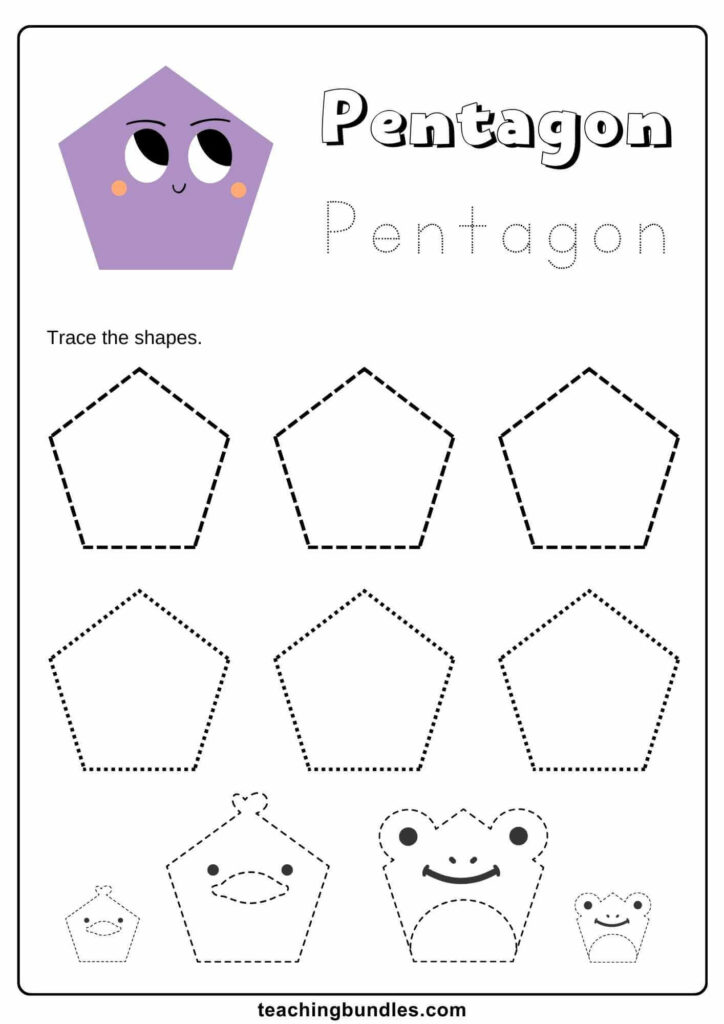
Targeted pencil control exercises focused specifically on five-sided polygons establish the foundation for complex letter and number formations later on. Tracing a pentagon introduces children to distinct vertices, straight lines, and directional shifts that do not occur naturally in standard circular scribbles. When working with these materials, young learners practice halting their momentum, changing angles deliberately, and maintaining contact between the writing utensil and the paper surface. Such actions directly strengthen the intrinsic hand muscles necessary for efficient pencil grasps. For more related activities, check out our Reindeer Shapes Tracing.
Key Learning Outcomes
Engaging with shape-based tracing sheets promotes visual-spatial awareness by teaching children to recognize and replicate distinct geometric boundaries. Hand-eye coordination improves as developing eyes guide the hand across defined paths from one vertex to the next. Stroke efficiency advances naturally when learners practice continuous linework and deliberate corner pivots. Furthermore, bilateral coordination solidifies because one hand must stabilize the paper while the dominant hand executes the tracing motion.
How to Use This Worksheet
Preparation involves printing the sheets on sturdy cardstock to prevent tearing and sliding during enthusiastic tracing attempts. Positioning the page directly in front of the child, slightly tilted to match the natural angle of the forearm, encourages optimal posture and wrist alignment. Encouraging the child to trace the pentagon with an index finger first helps map out the physical movement before introducing crayons, markers, or pencils. Transitioning from thick writing tools to thinner pencils gradually refines the pincer grasp over time.
Practical Tips for Parents and Teachers
Adults should model correct grip mechanics explicitly, showing how the thumb and index finger form a soft circle around the writing tool while resting it on the middle finger. Scaffolding the activity means starting with larger, tactile pentagons before moving down to standard paper sheets. Keeping sessions short, ideally lasting only five to ten minutes, prevents hand fatigue and maintains enthusiasm. Celebrating effort rather than perfection keeps motivation high when corners prove challenging to navigate.
Age-Appropriate Recommendations
According to the National Association for the Education of Young Children Developmentally Appropriate Practice guidelines, children aged two to four benefit most from sensory-rich, large-scale pre-writing experiences that emphasize gross motor arm movements and thick writing instruments. For older children approaching kindergarten and the primary grades, the focus shifts toward precision, spatial orientation, and refining pencil pressure on standard-sized worksheets. By tailoring the expectations to the developmental stage of the child, adults ensure that shape tracing remains a rewarding, confidence-building challenge rather than a source of frustration.
Visual-motor integration and fine motor control develop progressively through structured practice, laying the necessary groundwork for legible handwriting and geometric understanding in early childhood. — American Occupational Therapy Association
Frequently Asked Questions
Explore More Free Printable Tracing Worksheets
Expanding early childhood motor repertoires involves exploring diverse stroke patterns, curved lines, and structured geometric paths. Educators and caregivers can access a wide array of supplementary resources by visiting KidTraces.com to support developing writers. Explore dedicated collections for Shape And Line Tracing, build core control through Fine Motor And Pre-Writing Skills, or dive into letter mastery via Dotted Letters For Tracing. Every printable is carefully crafted to foster confidence, independence, and foundational literacy readiness across all developmental stages.
Developmental Milestone & Activity Table
| Development Stage | Recommended Daily Duration | Primary Learning Objective |
|---|---|---|
| Preschool & Pre-K | 10 – 15 Minutes | Pencil grip development & basic pre-stroke lines |
| Kindergarten | 15 – 20 Minutes | Letter/number formation & spatial line awareness |
| Early Elementary (Grade 1–2) | 20 – 30 Minutes | Fluency, sentence construction & neatness |
Images References