Introduction
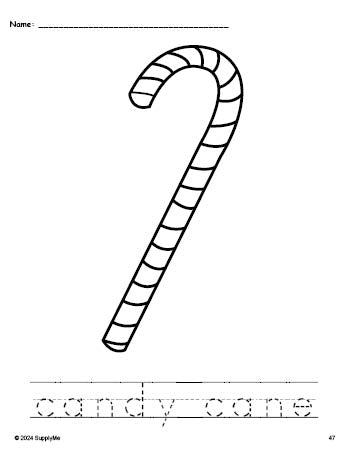
Many children recognize letters, shapes, and numbers long before their fine motor coordination and hand strength catch up to the physical demands of writing. According to the American Occupational Therapy Association, foundational fine motor control is essential for children to successfully participate in daily school-related tasks like handwriting and manipulating classroom tools. This developmental gap often frustrates eager learners who want to create marks on paper but lack the muscle endurance and motor planning required for complex pencil strokes. Seasonal printables bridge this gap effortlessly by disguising crucial foundational practice as a festive holiday activity. The candy cane line tracing worksheet transforms traditional pre-writing drills into a joyful, engaging challenge that captures a child’s attention during the busiest time of the school year.
💡 Educational Key Takeaways:
- Core Skill: Structured Candy Cane Line Tracing focused on developing pencil grip, stroke control, and early literacy/math confidence.
- Target Scope: Suited for homeschoolers, preschool, kindergarten, and elementary learners.
- Best Recommendation: Practice 10–15 minutes daily with ergonomic writing tools to reinforce muscle memory without hand fatigue.
What This Worksheet Covers
Festive tracing sheets target specific visual-motor integration skills necessary for early literacy and handwriting success without feeling like formal academic instruction. Navigating alternating curves, diagonal slants, and classic holiday shapes requires precise hand-eye coordination and sustained attention from young learners. It sounds simple, and that is the exact point of early childhood motor interventions. By utilizing familiar holiday imagery, educators and caregivers can invite children to practice continuous line control while following the iconic sweep of a candy cane. Children naturally learn to stabilize the paper with their non-dominant hand while keeping constant visual contact between the moving pencil tip and the target line. This specific visual-motor tracking directly supports the cognitive mapping needed later for reading fluency and mathematical grid alignment, as explored further within Shape and Line Tracing collections.
Key Learning Outcomes
Young learners develop enhanced bilateral coordination by holding the paper steady while moving a writing utensil across the page with the dominant hand. Pencil pressure regulation improves significantly as children navigate from thick starting points to delicate curving finishes without tearing the paper. Visual-spatial awareness strengthens as tiny eyes learn to track left-to-right trajectories, anticipating the upcoming turns and loops embedded within the festive designs. Hand strength and intrinsic muscle endurance build up naturally through sustained gripping and precise directional shifts during the tracing process. Exploring these foundational mechanics regularly helps children transition smoothly into more structured writing tasks found across Fine Motor and Pre-Writing Skills resources.
How to Use This Worksheet
Successful integration of holiday tracing pages relies on creating a low-stress environment where experimentation and repetition are celebrated equally. Adults should introduce the sheet by demonstrating proper stroke direction in the air first, modeling how the hand moves fluidly from top to bottom. It helps to slip the paper inside a heavy-duty clear dry-erase pocket and provide a dry-erase marker for children who experience early hand fatigue or frustration with permanent mistakes. This modification removes the permanence of pencil marks, allowing learners to erase and retry challenging curves without tears. When children master the basic paths, caregivers can explore additional holiday concepts available under Seasonal and Fun Themes to maintain high interest levels.
Practical Tips for Parents and Teachers
Encourage a functional tripod grasp by offering broken crayons, golf pencils, or short markers that naturally prevent a heavy fist grip. Adults should scaffold the activity by physically guiding a child’s hand through the first loop, then gradually fading support until the child completes the remaining paths independently. Scaffolded assistance ensures the child experiences immediate success rather than building frustration over difficult diagonal lines. Working on vertical surfaces, such as taping the printable to an upright easel or a refrigerator, naturally activates wrist extension and shoulder stabilization. According to Reading Rockets, multisensory pre-writing activities dramatically improve a child’s ability to retain directional strokes and form letters accurately on standard paper.
Age-Appropriate Recommendations
Developmental expectations vary wildly across early childhood, requiring distinct approaches for toddlers compared to early elementary students. For ages two through four, aligned with the National Association for the Education of Young Children Developmentally Appropriate Practice, the focus remains entirely on gross hand movements, sensory exploration, and simple straight or horizontal lines. Toddlers benefit from thick markers and oversized starting dots that accommodate developing palmar grasps. By ages five through eight, children enter the refinement stage where precision, pencil pressure control, and smooth directional changes take priority over simple mark-making. Older children should be encouraged to complete intricate curves without lifting the writing tool, refining the exact motor memory required for cursive and print letter formation.
Foundational fine motor control is essential for children to successfully participate in daily school-related tasks like handwriting and tool manipulation. — American Occupational Therapy Association
Frequently Asked Questions
Navigating early childhood motor development often raises practical questions for educators and families guiding young learners through pre-writing tasks. Clear answers regarding accessibility, skill progression, and developmental milestones help adults maximize the educational value of every printable activity.
Explore More Free Printable Tracing Worksheets
Supporting a young child’s journey toward confident handwriting requires a diverse library of engaging, targeted practice materials. Adults can discover hundreds of additional printables designed to build hand strength, pencil control, and letter formation by exploring the full library at KidTraces.com. Whether preparing a preschool classroom or organizing a homeschool curriculum, finding the right resources to match every developmental stage makes all the difference. Browse through specialized categories including Tracing Worksheets to build a comprehensive, joyful foundation for lifelong literacy.
Developmental Milestone & Activity Table
| Development Stage | Recommended Daily Duration | Primary Learning Objective |
|---|---|---|
| Preschool & Pre-K | 10 – 15 Minutes | Pencil grip development & basic pre-stroke lines |
| Kindergarten | 15 – 20 Minutes | Letter/number formation & spatial line awareness |
| Early Elementary (Grade 1–2) | 20 – 30 Minutes | Fluency, sentence construction & neatness |
Images References