Introduction
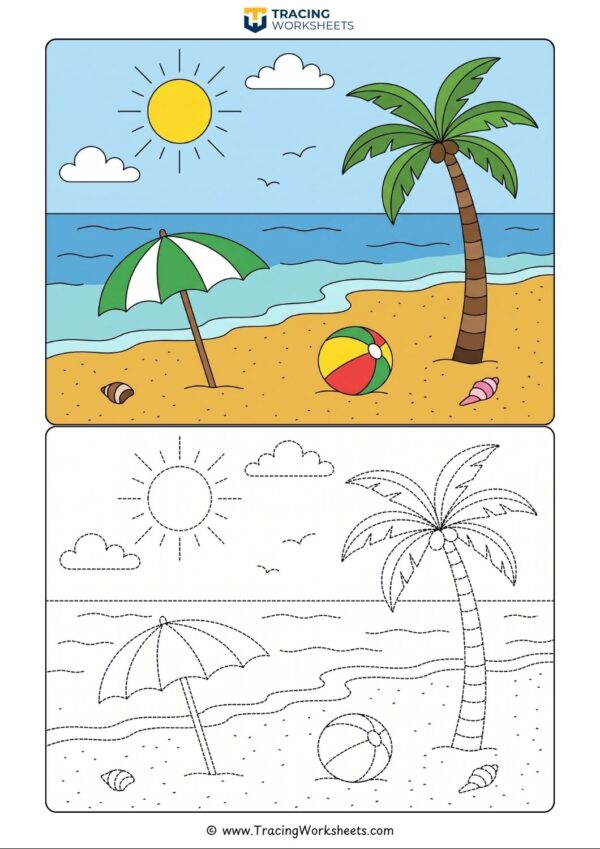
Many children recognize letters, shapes, and pictures long before their fine motor coordination and hand strength catch up to comfortably form them on paper. According to the American Occupational Therapy Association, foundational fine motor control is built through engaging, playful interventions that prepare small hands for complex writing tasks. Seasonal imagery provides an immediate bridge between familiar real-world experiences and pencil control. Integrating a thematic worksheet like the beach tracing image invites children to explore curves, horizontal paths, and vertical coordination without feeling the pressure of formal penmanship drills. It sounds simple, and that is precisely the point. When the cognitive load of forming abstract letters is removed, attention shifts entirely to smooth pencil flow, proper posture, and sustained visual-motor integration.
💡 Educational Key Takeaways:
- Core Skill: Structured The Beach Tracing Image focused on developing pencil grip, stroke control, and early literacy/math confidence.
- Target Scope: Suited for homeschoolers, preschool, kindergarten, and elementary learners.
- Best Recommendation: Practice 10–15 minutes daily with ergonomic writing tools to reinforce muscle memory without hand fatigue.
What This Worksheet Covers
The beach tracing image targets foundational pre-writing strokes by combining horizontal waves, looping seagulls, and diagonal seashell pathways into a cohesive seaside landscape. Children navigate smooth lines that mimic ocean waves, zigzag patterns that encourage directional changes, and gentle loops that build fluid wrist movement. These specific stroke pathways mirror the fundamental pre-writing lines children must master before attempting letters and numbers. Exploring these patterns within a cohesive coastal theme transforms repetitive drills into an imaginative journey along the shoreline. Furthermore, this style of resource supports hand-eye coordination by requiring constant visual tracking as the hand moves across the page from left to right, laying vital groundwork for early literacy and reading readiness. For more related activities, check out our Soccerball Trce.
Key Learning Outcomes
Working through these seaside paths strengthens intrinsic hand muscles, improves pincer grasp endurance, and refines bilateral coordination as one hand stabilizes the paper while the other controls the writing tool. According to Reading Rockets, visual-motor integration—the ability to coordinate what the eyes see with what the hands do—is a primary predictor of early academic success. Children naturally refine pencil pressure control as they navigate alternating wave widths, learning to press lighter for delicate loops and firmer for bold shorelines. Spatial awareness also improves as young learners track lines from edge to edge, establishing natural left-to-right scanning patterns that transfer directly into independent reading and writing fluency.
How to Use This Worksheet
Preparation and environment dictate the success of any fine motor activity involving young learners. Setting up a stable workspace with a child-sized chair and an appropriately angled writing surface instantly promotes a functional grasp. Educators and caregivers often slide the printable inside a heavy-duty dry-erase pocket, transforming a single-use sheet into a reusable tracing board where children can practice fluid strokes with a dry-erase marker. Tracing over thicker lines first using a finger or a chunky crayon helps kinesthetic learners feel the movement before switching to a standard pencil or colored pen. Encouraging a relaxed, upright posture ensures that the shoulder and forearm muscles remain free to guide the hand effortlessly across the page.
Practical Tips for Parents and Teachers
Adults play a powerful role by modeling correct grip and offering gentle physical guidance without taking over the pencil movement. Scaffolding the experience involves starting with larger, gross-motor tracing motions in the air or on a vertical easel before moving down to the paper surface. When a child tires, pausing the session prevents fatigue-induced poor habits from forming in the fingers and wrist. Extending the activity is easy by grabbing tactile manipulatives like small seashells or glass beads to place along the traced lines after the pencil work is finished. Keeping sessions short, positive, and playful ensures children remain motivated and eager to practice their emerging pencil control skills day after day.
Age-Appropriate Recommendations
For younger children ages two through four, aligning activities with the National Association for the Education of Young Children Developmentally Appropriate Practice means focusing on large, sweeping arm movements, thick writing utensils, and finger-tracing rather than strict pencil precision. Toddlers thrive when allowed to explore the seaside shapes using vibrant markers or finger paints directly on the sheet. Conversely, children ages five through eight benefit from refining their precision, utilizing standard pencils, and focusing on maintaining continuous contact between the pencil tip and the dotted pathways. At this older stage, the worksheet serves as a fantastic warm-up tool before transitioning into formal handwriting lessons found within collections like Fine Motor and Pre-Writing Skills or broader units available under Seasonal and Fun Themes.
Visual-motor integration and fine motor dexterity strongly predict early writing and literacy outcomes in young children. — American Occupational Therapy Association
Frequently Asked Questions
Finding the right tools and strategies makes all the difference when supporting developing writers at home or inside a bustling classroom environment. Below are quick answers to common questions regarding implementation and skill development.
Explore More Free Printable Tracing Worksheets
Supporting a child’s journey toward confident writing requires a diverse library of engaging, low-stress practice materials. Beyond seasonal favorites, expanding practice into structured letter formation is simple with resources dedicated to Dotted Letters For Tracing. When ready to tackle character and number recognition, explore the extensive selection housed within Alphabet And Numbers Tracing. Every child progresses at an individualized pace, and having access to a rich variety of printable materials ensures practice always remains fresh, fun, and developmentally appropriate. Discover the complete collection of resources designed to nurture confident young learners by visiting KidTraces.com today.
Developmental Milestone & Activity Table
| Development Stage | Recommended Daily Duration | Primary Learning Objective |
|---|---|---|
| Preschool & Pre-K | 10 – 15 Minutes | Pencil grip development & basic pre-stroke lines |
| Kindergarten | 15 – 20 Minutes | Letter/number formation & spatial line awareness |
| Early Elementary (Grade 1–2) | 20 – 30 Minutes | Fluency, sentence construction & neatness |
Images References