Introduction
Many children recognize letters, numbers, and geometric forms long before their small hand muscles possess the endurance and dexterity required to comfortably form them on paper. According to the American Occupational Therapy Association, foundational fine motor control and bilateral coordination are critical prerequisites for successful handwriting and classroom participation. Educators and therapists often observe young learners eager to create symbols while struggling to coordinate the pencil, paper, and stabilizing hand simultaneously. Bridging this gap requires thoughtful preparation through targeted pre-writing practice that builds hand strength without causing frustration. The diamond trace preschool printable serves as an exceptional tool for this developmental stage, offering structured opportunities to master diagonal lines and intersecting angles that many basic straight-line worksheets miss.
💡 Educational Key Takeaways:
- Core Skill: Structured Diamond Trace Preschool focused on developing pencil grip, stroke control, and early literacy/math confidence.
- Target Scope: Suited for homeschoolers, preschool, kindergarten, and elementary learners.
- Best Recommendation: Practice 10–15 minutes daily with ergonomic writing tools to reinforce muscle memory without hand fatigue.
What This Worksheet Covers
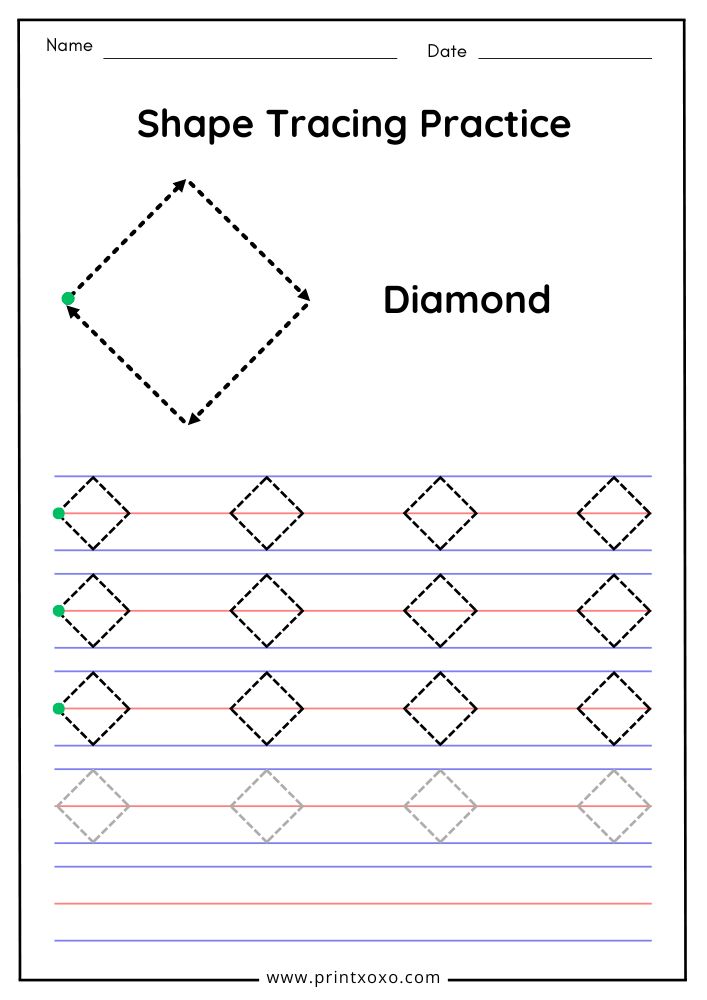
Geometrical shapes like diamonds present unique visual-motor challenges because they require continuous directional changes and precise corner pivots. Mastering the diagonal strokes found within a diamond requires advanced wrist rotation and visual-spatial planning that standard vertical or horizontal lines do not demand. This particular worksheet guides children through the process of controlled pencil movement, shifting attention from simple tracing to intentional stroke execution. It bridges the gap between basic Shape and Line Tracing and complex symbol formation by isolating the diagonal components that eventually make up letters like k, v, w, and x.
Key Learning Outcomes
Working consistently with diagonal-focused tracing materials fosters refined visual-motor integration, allowing eyes and hands to communicate seamlessly during intricate tasks. Children develop enhanced pencil control by learning to regulate speed and pressure as the writing tool approaches sharp corners and directional shifts. Hand strength and intrinsic muscle stability improve naturally as tiny fingers maintain a functional grasp while navigating slanted trajectories across the page. Furthermore, learners build essential spatial awareness by understanding how shapes occupy space on a flat surface, laying the groundwork for proper letter alignment and spacing later in life. These combined outcomes ensure that emerging writers gain confidence before moving on to intricate Alphabet And Numbers Tracing activities in the classroom.
How to Use This Worksheet
Successful implementation begins long before putting a pencil to paper, starting with proper postural stability and body alignment. Ensure the workspace features a chair and table height that allows the child’s feet to rest flat on the floor and elbows to bend at a comfortable ninety-degree angle. Encourage starting points clearly indicated on the page, reinforcing directional habits from top to bottom and left to right. It sounds simple, and that is the point, but slowing down the tracing process yields far better motor memory than rushing through multiple sheets.
Practical Tips for Parents and Teachers
Scaffolding instruction makes a tremendous difference in how a child perceives their own capability during pencil-and-paper tasks. Begin by modeling the correct stroke in the air or on a vertical surface like an easel, which naturally promotes an extended wrist and functional grip. If hand fatigue sets in early, temporarily switch to thicker writing utensils like short crayons or broken chalk pieces to encourage a natural tripod grasp. When children struggle with the sharp angles of the diamond, gently guide their hand through the first couple of repetitions before letting them complete the rest independently. For additional practice with foundational strokes, incorporating resources from Fine Motor and Pre-Writing Skills can further support muscle development and endurance.
Age-Appropriate Recommendations
Developmental expectations vary significantly between toddlers and early elementary students, making tailored approaches essential for success. For children ages two to four, the focus should remain on gross motor engagement, thick writing tools, and exploring simple Dotted Letters For Tracing without rigid expectations for perfection. According to the National Association for the Education of Young Children guidelines on developmentally appropriate practice, preschoolers learn best through hands-on exploration that respects individual timelines for fine motor maturation. By ages five to eight, children transition into refined pencil control, accurately executing complex geometric shapes, mastering stroke order, and building the stamina required for extended writing tasks.
Foundational fine motor control and bilateral coordination are critical prerequisites for successful handwriting and classroom participation. — American Occupational Therapy Association (AOTA)
Frequently Asked Questions
Finding the right approach to early writing can raise many questions for educators and families navigating skill development at home or in the classroom.
Explore More Free Printable Tracing Worksheets
Supporting a young writer involves offering a wide variety of engaging, low-pressure practice materials that adapt to their changing interests and abilities. Whether focusing on seasonal motifs found in Seasonal and Fun Themes or foundational literacy practice, having access to reliable resources makes all the difference. Explore the full library of educational resources, classroom printables, and skill-building activities available anytime at KidTraces.com to keep the learning journey fresh, fun, and developmentally appropriate.
Developmental Milestone & Activity Table
| Development Stage | Recommended Daily Duration | Primary Learning Objective |
|---|---|---|
| Preschool & Pre-K | 10 – 15 Minutes | Pencil grip development & basic pre-stroke lines |
| Kindergarten | 15 – 20 Minutes | Letter/number formation & spatial line awareness |
| Early Elementary (Grade 1–2) | 20 – 30 Minutes | Fluency, sentence construction & neatness |
Images References