Introduction
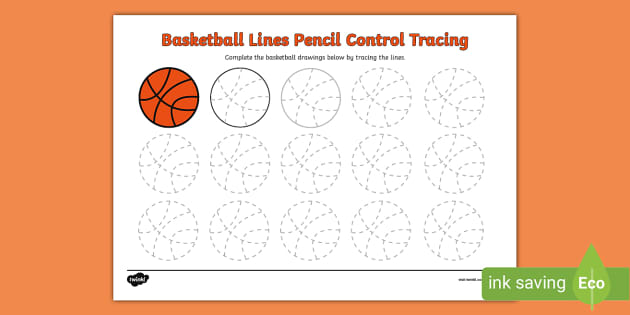
Many young children recognize letters and shapes long before their fine motor control allows them to successfully form them on paper. According to the National Association for the Education of Young Children (NAEYC), meaningful play-based and themed activities provide the essential foundation for early academic success by engaging children in purposeful motor tasks. Introducing seasonal and motivational motifs helps bridge that exact gap between cognitive understanding and physical execution. The free printable basketball tracing outline offers a purposeful avenue for channeling enthusiasm into structured hand movements. It sounds simple, and that’s the point. By transforming basic pencil control exercises into an engaging sports theme, adults can maintain high interest levels while children build crucial hand-eye coordination.
💡 Educational Key Takeaways:
- Core Skill: Structured Basketball Tracing Outline focused on developing pencil grip, stroke control, and early literacy/math confidence.
- Target Scope: Suited for homeschoolers, preschool, kindergarten, and elementary learners.
- Best Recommendation: Practice 10–15 minutes daily with ergonomic writing tools to reinforce muscle memory without hand fatigue.
What This Worksheet Covers
This resource focuses heavily on seasonal and fun themes to drive motivation and engagement during early writing sessions. Children often resist standard drill-and-practice sheets, viewing them as tedious schoolwork rather than enjoyable learning opportunities. The basketball tracing outline utilizes a familiar, energetic concept that invites learners to trace continuous curves, concentric circles, and intersecting grid lines modeled after a standard basketball graphic. This layout challenges the small muscles of the hand to execute smooth, controlled arcs instead of stiff, jagged marks. Practitioners frequently observe that when children focus on a recognizable object like a basketball, their grip naturally shifts toward better functional alignment because the brain prioritizes the visual goal over the mechanical task of holding a pencil. For more related activities, check out our Happy Birthday Text Trace.
Key Learning Outcomes
Targeted skill development occurs naturally as learners navigate the curved boundaries of the basketball design. The primary outcome involves enhancing bilateral coordination, requiring one hand to stabilize the paper while the dominant hand executes precise pencil strokes. Additionally, visual-motor integration improves significantly as young minds translate what the eyes see into steady hand movements along the dotted paths. Learners also strengthen intrinsic hand muscles responsible for finger dexterity, which directly influences future handwriting legibility, cutting endurance, and utensil management during daily self-help routines. Finally, sustained attention spans expand because the engaging athletic motif encourages persistence through the entire drawing exercise without requiring heavy verbal prompting from adults.
How to Use This Worksheet
Implementation requires thoughtful preparation of the physical workspace to encourage optimal posture and wrist extension. Securing the paper with low-tack tape prevents frustrating sliding movements that often disrupt a child’s concentration. Adults should encourage starting at the top left of the circular outline, modeling how the wrist rotates fluidly rather than locking up during the curve. According to the American Occupational Therapy Association (AOTA), positioning the writing surface on a slight slant promotes a natural wrist extension that reduces hand fatigue during extended fine motor tasks. Transitioning from thick crayons to standard pencils or thin markers allows learners to experience varying degrees of resistance, helping them calibrate the exact amount of downward pressure needed for clean lines.
Practical Tips for Parents and Teachers
Scaffolding the activity makes a profound difference for children who struggle with initial pencil control. Adults can begin by guiding a hand over the child’s hand to physically demonstrate the smooth curving motion required around the basketball perimeter. Fading that physical assistance gradually builds independent mastery as the child takes full control of the writing tool. Incorporating multisensory elements enhances retention, such as having the child trace the outline with a finger in the air or over a textured cardboard cutout before putting graphite to paper. Offering positive reinforcement centered on effort and steady pacing rather than perfection keeps frustration levels low and intrinsic motivation high. Stashing a few extra copies allows for repeated practice across different mediums, transforming a single printable into a versatile fine motor station.
Age-Appropriate Recommendations
Toddlers and preschoolers aged two to four benefit most from using thick writing tools on an enlarged version of the printable to practice basic gross motor control of the arm and shoulder. According to the Centers for Disease Control and Prevention (CDC) developmental milestones, children in this age bracket are actively refining the ability to imitate vertical and horizontal lines, making simple curved outlines a natural next step. Kindergartens and early elementary students aged five to eight can use the standard-sized basketball tracing outline to refine pencil pressure, master tripod grasp endurance, and practice controlled directional strokes aligned with early writing expectations found in foundational developmental frameworks. Tailoring the writing instrument to the child’s current developmental stage ensures that practice remains a confidence-building experience rather than a source of physical strain.
Developmental Milestones — According to the Centers for Disease Control and Prevention (CDC), children develop refined hand-eye coordination and pre-writing stroke imitation skills progressively between the ages of three and five, laying the physical groundwork for formal handwriting.
Frequently Asked Questions
Clear guidance helps families and educators maximize the benefits of fine motor practice resources. The answers below address common inquiries regarding printing logistics, developmental progression, and trusted institutional standards.
Fine Motor Foundations — According to the American Occupational Therapy Association (AOTA), targeted pre-writing activities and shape tracing significantly enhance the foundational hand strength and visual-motor integration required for academic success.
Explore More Free Printable Tracing Worksheets
Expanding a child’s collection of practice materials supports continuous skill growth across multiple developmental domains. Adults can discover a rich variety of exercises designed to build fundamental proficiencies by exploring the Fine Motor and Pre-Writing Skills category. For learners ready to tackle letter formation, the curated Dotted Letters For Tracing selection provides structured guidance. Those who enjoy themed practice can find more engaging options within the Seasonal and Fun Themes archive. Every tool available across the entire library at KidTraces.com aims to make early skill-building accessible, joyful, and effective for every young learner.
Developmental Milestone & Activity Table
| Development Stage | Recommended Daily Duration | Primary Learning Objective |
|---|---|---|
| Preschool & Pre-K | 10 – 15 Minutes | Pencil grip development & basic pre-stroke lines |
| Kindergarten | 15 – 20 Minutes | Letter/number formation & spatial line awareness |
| Early Elementary (Grade 1–2) | 20 – 30 Minutes | Fluency, sentence construction & neatness |
Images References