Introduction
Children frequently recognize numerals and understand basic quantities long before tiny hand muscles possess the endurance or dexterity required to form those numbers on paper. According to the National Association for the Education of Young Children (NAEYC), meaningful early mathematical experiences must be hands-on and developmentally appropriate, bridging cognitive understanding with physical execution. Many classrooms and clinic spaces observe this exact gap between a child’s bright intellect and their early pencil control. That disconnect is where targeted practice becomes essential. Engaging with free printable tools like the tracing numbers part of mathematical thinking domain provides children with structured pathways to connect abstract mathematical concepts with concrete motor outputs. It sounds simple, and that’s the point: purposeful repetition builds the neural pathways necessary for fluid numeral formation.
💡 Educational Key Takeaways:
- Core Skill: Structured Tracing Numbers Part Of Mathematical Thinking Domain focused on developing pencil grip, stroke control, and early literacy/math confidence.
- Target Scope: Suited for homeschoolers, preschool, kindergarten, and elementary learners.
- Best Recommendation: Practice 10–15 minutes daily with ergonomic writing tools to reinforce muscle memory without hand fatigue.
What This Worksheet Covers
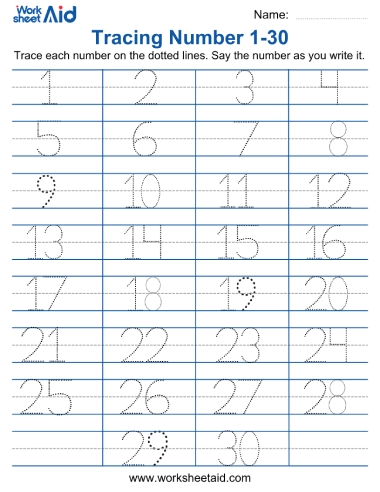
This specific printable focuses entirely on numeral formation, stroke order, and spatial awareness within the broader scope of mathematical readiness. Every digit from zero through nine receives dedicated space, featuring clear directional arrows and distinct starting dots that guide young hands along the correct path. The layout prevents visual clutter, allowing developing eyes and hands to focus strictly on the motor plan for each individual number. Beyond the physical strokes, this worksheet reinforces mathematical thinking by pairing visual quantities with the written symbol, helping learners associate the shape of a number with its actual value. Children explore foundational pre-writing curves, straight lines, and diagonal slants that recur across multiple digits. Through this structured format, learners transition from random scribbling to intentional, controlled line production. Exploring the wider collection of Tracing Number resources reveals even more ways to reinforce these exact mathematical and motor foundations.
Key Learning Outcomes
Engaging with these numbered pathways fosters correct stroke sequencing, ensuring children learn to start numerals from the top rather than developing inefficient bottom-up habits. Hand-eye coordination improves dramatically as pencils follow precise dotted trajectories instead of wandering freely across blank pages. Spatial orientation also strengthens, teaching little learners how to contain symbols neatly within designated writing lines without floating off the baseline. Furthermore, muscle memory develops through consistent repetition, gradually transforming clumsy finger grips into automatic, fluid movements. Finally, cognitive number recognition solidifies as the physical act of tracing imprints the visual form of each digit deeply into long-term memory.
How to Use This Worksheet
Successful implementation begins by setting up a comfortable, ergonomic workstation where feet rest flat on the floor and the paper rests at a slight upward angle. Adults should guide the initial attempts, modeling the correct verbal cues for each stroke, such as “straight down and around for the number two.” Encouraging children to use their index finger as a pointer before touching a pencil to paper helps internalize the directional flow. Lamination or slipping the page into a clear dry-erase pocket turns a single sheet into a reusable canvas for endless low-pressure practice. When working on foundational fine motor controls alongside numbers, pairing this tool with resources from Shape and Line Tracing ensures well-rounded pre-writing development.
Practical Tips for Parents and Teachers
Observe how the child grasps the writing utensil, gently correcting a tightly clenched fist into a functional tripod or quadrupod grasp before bad habits set in. Scaffold the experience by allowing thicker markers or crayons during early attempts, which provide tactile feedback and require less downward pressure than standard pencils. Keep sessions short, celebrating small victories like successfully curving the top of a three or closing the loop of a six. Extend the activity naturally by having the child trace the number and then count out physical objects like blocks or buttons to match that digit. For comprehensive daily routines that build foundational strength, incorporating exercises found in Fine Motor and Pre-Writing Skills prepares little hands for sustained writing tasks.
Age-Appropriate Expectations
Children between ages two and four typically explore pre-writing strokes through large, whole-arm movements, making vertical and horizontal lines rather than precise numerals. According to Handwriting Without Tears developmental progressions, toddlers benefit most from multisensory tracing, finger-painting digits, and large-motor air-writing before tackling fine-tipped pencils. By ages five through eight, children enter the formal schooling phase where mastering standard numeral formation becomes an expected part of early academic standards, such as Kindergarten mathematics benchmarks. During these primary years, fine motor stamina increases, allowing for accurate baseline placement, consistent sizing, and independent stroke sequencing without adult hand-over-hand assistance.
Young children develop foundational writing strokes and visual-motor integration in a predictable sequence, moving from horizontal and vertical lines toward complex diagonal and curved letter and number formations by early elementary school. — American Occupational Therapy Association (AOTA)
Frequently Asked Questions
Explore More Free Printable Tracing Worksheets
Supporting a young learner through the exciting journey of early literacy and numeracy requires a steady supply of engaging, high-quality practice materials. Every child develops at an individualized pace, meaning access to diverse, adaptable resources makes all the difference in building confidence. Educators, therapists, and families can discover a comprehensive library designed to nurture pencil control, stroke accuracy, and cognitive readiness by visiting the main hub at KidTraces.com today.
Developmental Milestone & Activity Table
| Development Stage | Recommended Daily Duration | Primary Learning Objective |
|---|---|---|
| Preschool & Pre-K | 10 – 15 Minutes | Pencil grip development & basic pre-stroke lines |
| Kindergarten | 15 – 20 Minutes | Letter/number formation & spatial line awareness |
| Early Elementary (Grade 1–2) | 20 – 30 Minutes | Fluency, sentence construction & neatness |
Images References