Introduction
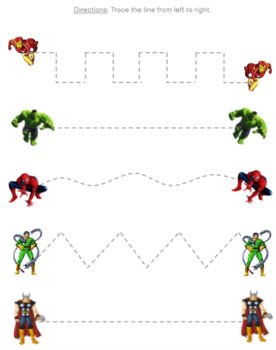
Many children recognize letters, shapes, and symbols long before their fine motor skills possess the strength and dexterity to form them on paper. This common disconnect often leads to frustration during early writing instruction if adults push too hard, too fast. According to the American Occupational Therapy Association, foundational fine motor control and visual-motor integration are essential precursors to functional handwriting success in early childhood. Engaging thematic printables bridge that developmental gap by turning rigorous pencil control practice into an imaginative mission. Enter the free printable superhero line tracing sheet, designed to capture wandering attention through heroic motifs while quietly building the hand strength required for future literacy. It sounds simple, and that’s the point. By transforming vertical, horizontal, diagonal, and curved lines into dynamic flight paths, children stay motivated to complete stroke sequences without the boredom often associated with traditional drills. This resource belongs on every desk, kitchen table, and easel where early learners gather to build confidence and coordination.
💡 Educational Key Takeaways:
- Core Skill: Structured Superhero Line Tracing focused on developing pencil grip, stroke control, and early literacy/math confidence.
- Target Scope: Suited for homeschoolers, preschool, kindergarten, and elementary learners.
- Best Recommendation: Practice 10–15 minutes daily with ergonomic writing tools to reinforce muscle memory without hand fatigue.
What This Worksheet Covers
The superhero line tracing printable focuses primarily on pre-writing strokes, which serve as the geometric building blocks for every letter of the alphabet and every numeral. Rather than forcing children directly into complex letter formation, this exercise isolates the exact movements required for pencil control: steady horizontal tracking, smooth vertical descents, controlled diagonal slants, and fluid loops or zig-zags. Here’s what makes this worksheet different: it connects visual-motor planning directly with dynamic, thematic storylines where a hero must navigate obstacles, fly through the clouds, or speed across cityscapes. Children trace dotted and dashed pathways that gradually increase in complexity across the page. This intentional progression allows educators and caregivers to observe whether a child struggles with crossing the midline, maintaining consistent downward pressure, or changing direction smoothly. Ultimately, mastering these foundational strokes lays the groundwork for navigating more advanced Shape and Line Tracing activities without hand fatigue.
Key Learning Outcomes
Working through these heroic pathways promotes rapid development across several critical domains of early childhood readiness. First, children refine their visual-motor integration, learning to coordinate what the eye sees with the precise physical movement of the hand. Second, the repetitive execution of varied line formations builds intrinsic hand strength, specifically within the lumbricals and interossei muscles of the palm and fingers. Third, learners naturally develop directional awareness, consistently practicing the standard Western writing progression from left to right and top to bottom. Fourth, the activity fosters sustained attention span and task persistence, as children feel a genuine sense of accomplishment upon safely guiding their hero to the finish line. Finally, this targeted stroke practice enhances bilateral coordination, teaching the non-dominant stabilizing hand how to hold the paper firmly while the dominant hand executes the tracing task.
How to Use This Worksheet
Maximizing the benefits of any pre-writing printable requires careful attention to the physical setup before a single mark is made on the page. Adults should verify that the child sits with feet flat on the floor, hips and knees at ninety-degree angles, and forearms resting comfortably on a stable table surface. Printing out the sheet on heavier cardstock or sliding it into a dry-erase pocket sleeve instantly transforms the paper into a reusable asset that invites multiple practice attempts. When children use washable markers or dry-erase markers instead of standard pencils, the reduced friction makes the tracking motion smoother, which prevents early hand cramping. Caregivers can also turn the activity into a storytelling adventure by asking the child to narrate the hero’s journey aloud while tracing, which weaves oral language development directly into the fine motor exercise.
Practical Tips for Parents and Teachers
Guiding an early learner requires a balance of gentle modeling and supportive scaffolding to keep frustration at bay. Begin by demonstrating an efficient tripod or quadrupod grasp on a separate sheet of paper, highlighting how the thumb and index finger form a soft circle around the writing utensil. If a child shows signs of hand fatigue or begins wrapping their fist tightly around the marker, pause the session immediately and introduce a quick hand-stretching game like finger push-ups or spider walks. For children who struggle to stay on the dotted path, scaffold the experience by placing tactile barriers or using a colorful highlighter to thicken the initial stroke line. As confidence grows, gradually remove these supports to encourage independent visual tracking, preparing them to tackle broader Fine Motor and Pre-Writing Skills across the curriculum.
Age-Appropriate Recommendations
According to the National Association for the Education of Young Children Developmentally Appropriate Practice guidelines, motor skill acquisition occurs along a predictable continuum that varies significantly between toddlers and early elementary students. For children ages two to four, the focus should remain heavily on gross directional lines, large horizontal tracking, and thick, continuous strokes that accommodate a palmar or transitional grasp. At this stage, perfection is entirely secondary to participation and exploring movement on paper. For children ages five to eight, the expectations shift toward precision, pencil control, and utilizing a mature dynamic tripod grasp to navigate intricate zig-zags, loops, and diagonal paths without veering off course. This older cohort benefits greatly from pairing superhero line tracing exercises with targeted Alphabet And Numbers Tracing to bridge graphic strokes directly into formal literacy.
Foundational fine motor control and visual-motor integration are essential precursors to functional handwriting success in early childhood. — American Occupational Therapy Association
Frequently Asked Questions
Navigating early childhood education resources can raise questions for busy educators and parents. The answers below address the most common inquiries regarding how to implement this printable effectively.
Explore More Free Printable Tracing Worksheets
Supporting a developing writer involves offering a diverse array of engaging, thematic practice materials that adapt to evolving abilities. Every child responds differently to various visual stimuli, making it helpful to rotate through a rich variety of themed templates throughout the school year. Educators and caregivers can browse the complete library of teacher-approved resources designed to make pencil control fun by visiting KidTraces.com today for more inspiration.
Developmental Milestone & Activity Table
| Development Stage | Recommended Daily Duration | Primary Learning Objective |
|---|---|---|
| Preschool & Pre-K | 10 – 15 Minutes | Pencil grip development & basic pre-stroke lines |
| Kindergarten | 15 – 20 Minutes | Letter/number formation & spatial line awareness |
| Early Elementary (Grade 1–2) | 20 – 30 Minutes | Fluency, sentence construction & neatness |
Images References