Introduction
Many children recognize letters, identify sounds, and spell out loud long before their tiny hand muscles possess the endurance to form those same characters on paper. According to the National Association for the Education of Young Children (NAEYC), early writing is a developmental process where children use drawing, scribbling, and letter-like forms to communicate long before mastering conventional orthography. Bridging this gap between cognitive readiness and physical capability requires intentional tools that respect hand fatigue while building muscle memory. Guided letter tracing provides a structured, supportive bridge for young learners taking their first steps into formal handwriting. Every time a child sits down with a well-designed worksheet, physical coordination, visual-spatial awareness, and pre-literacy confidence develop in tandem. It sounds simple, and that’s the point: clear starting points and directional arrows remove the guesswork, transforming frustration into fluid pencil control.
💡 Educational Key Takeaways:
- Core Skill: Structured Guided Letter Tracing focused on developing pencil grip, stroke control, and early literacy/math confidence.
- Target Scope: Suited for homeschoolers, preschool, kindergarten, and elementary learners.
- Best Recommendation: Practice 10–15 minutes daily with ergonomic writing tools to reinforce muscle memory without hand fatigue.
What This Worksheet Covers
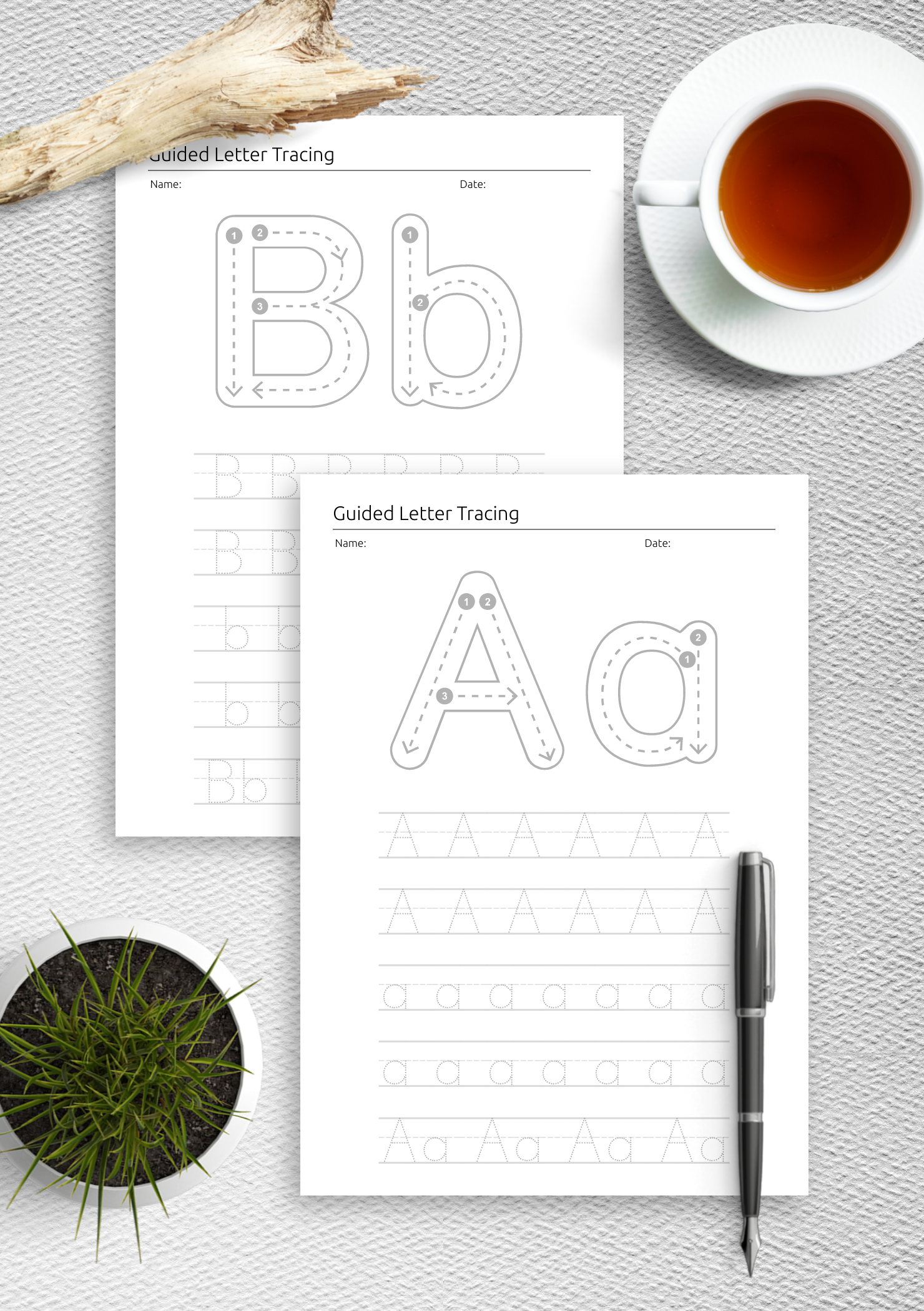
Mastering the alphabet and numerals requires more than simply copying shapes; it demands an understanding of stroke sequence, spatial boundaries, and proportional sizing. This printable focuses heavily on correct letter formation, emphasizing starting points, continuous lines, and directional arrows that guide the hand naturally across the page. Children often develop bad habits like starting letters from the bottom up, which drastically slows down writing speed later in elementary school. By utilizing clear visual anchors, the layout encourages proper motor planning from the very first stroke. The materials also build foundational strength by transitioning from gross motor pre-writing lines into precise, controlled character formation. Exploring these concepts alongside related resources like Alphabet And Numbers Tracing ensures a comprehensive approach to foundational literacy.
Key Learning Outcomes
Children engaging with these guided pages build essential visual-motor integration skills that translate directly to everyday academic tasks. Learners internalize directional consistency by consistently starting at the top left and moving downward and rightward across the page. Fine motor precision improves noticeably as tiny fingers learn to grade pressure, keeping lines steady rather than heavy and jagged. Letter recognition deepens because the tactile act of tracing reinforces the visual shape of each character in the brain’s memory centers. Furthermore, sustained attention span grows naturally as children complete short, manageable rows of letters without feeling overwhelmed by blank spaces. These cumulative benefits create a rock-solid foundation for future writing fluency.
How to Use This Worksheet
Success with handwriting printables depends heavily on the environment and the physical setup provided before the pencil ever touches the paper. Positioning the child with feet flat on the floor and hips at a ninety-degree angle immediately provides the core stability needed for distal hand control. Adults should observe how the pencil is held, encouraging a functional grasp without forcing an unnatural grip that causes hand cramping. Sliding the worksheet slightly to match the angle of the child’s writing arm makes directional strokes much more ergonomic. Pairing these paper exercises with multisensory exploration—such as tracing letters in sand or forming them with playdough—solidifies the brain-body connection before moving back to graphite. For those seeking broader foundational practice, incorporating activities from Fine Motor and Pre-Writing Skills adds tremendous value to the daily routine.
Practical Tips for Parents and Teachers
Scaffolding instruction effectively means meeting the child at the exact current level of development rather than forcing hurried progress. Adults should always model the correct stroke sequence first, talking through the movement out loud so the child hears the rhythm of the lines. Using colored markers for the starting dot adds an element of visual engagement that naturally draws the eye to the correct location. It remains crucial to prioritize quality over quantity, meaning three beautifully traced letters hold far more developmental value than a whole page of rushed scribbles. When hand fatigue sets in, which often looks like slumping or a sudden deterioration in grip, pause the activity immediately. Continuing past the point of fatigue only reinforces poor mechanics and builds negative associations with writing tasks.
Age-Appropriate Recommendations
According to the American Occupational Therapy Association (AOTA), children typically progress through predictable stages of grasp and pre-writing skill acquisition as their intrinsic hand muscles mature. For ages two through four, aligning with early childhood development frameworks, the focus should remain heavily on large movements, vertical surfaces, and thick writing utensils that encourage palmar and digital pronate grasps. Worksheets at this stage are best utilized for sensory exploration and gross motor line control rather than rigid letter perfection. As children enter the five-to-eight age bracket, developmental expectations shift toward standard kindergarten and early elementary benchmarks, such as those outlined in Common Core ELA standard L.K.1.a, which requires printing uppercase and lowercase letters. At this older stage, guided tracing directly supports the transition to independent handwriting, proper line placement, and appropriate letter sizing on standard primary paper. To find specialized variations tailored to specific seasons or skill levels, browsing through options like Seasonal and Fun Themes keeps motivation high throughout the school year.
Early writing development relies on visual-motor integration and core postural stability — American Occupational Therapy Association (AOTA)
Frequently Asked Questions
Navigating early handwriting milestones often brings up common questions regarding pacing, tools, and developmental readiness. The answers below address the most frequent inquiries from educators and families supporting young writers.
Handwriting practice enhances letter recognition and working memory in early childhood — Reading Rockets
Explore More Free Printable Tracing Worksheets
Supporting a young writer involves offering a rich variety of fresh, engaging practice materials that prevent boredom and target specific developmental milestones. Every child moves at an individual pace, meaning access to diverse layouts makes all the difference in maintaining enthusiasm for practice. Exploring the full library of resources available at KidTraces.com provides endless opportunities to nurture confidence, pencil control, and early literacy skills. Families and educators can effortlessly locate targeted pages by browsing categories dedicated to Dotted Letters For Tracing as well as Shape and Line Tracing. Consistency, encouragement, and the right tools will always pave the way for lifelong writing success.
Developmental Milestone & Activity Table
| Development Stage | Recommended Daily Duration | Primary Learning Objective |
|---|---|---|
| Preschool & Pre-K | 10 – 15 Minutes | Pencil grip development & basic pre-stroke lines |
| Kindergarten | 15 – 20 Minutes | Letter/number formation & spatial line awareness |
| Early Elementary (Grade 1–2) | 20 – 30 Minutes | Fluency, sentence construction & neatness |
Images References