Introduction
Many children recognize letters, numbers, and shapes long before their fine motor skills can actually form them on paper. According to the American Occupational Therapy Association, foundational hand strength and pencil control must develop progressively before a child can master legible handwriting. When young learners look up at the night sky, their curiosity naturally expands toward stars, rockets, and planets. That cosmic wonder provides a powerful hook for early childhood education. Integrating space themes into daily routines captures the imagination of young learners while addressing essential pre-writing foundations. This free printable tracing worksheets space for kindergarten resource transforms standard pencil practice into an interstellar mission. Children guide rockets along vertical lines, circle around planetary loops, and navigate constellations with growing confidence. Every curved line and dotted segment bridges the gap between cognitive understanding and physical execution. It sounds simple, and that is the point. Intentional design makes complex motor planning accessible, engaging, and entirely frustration-free for children stepping into the world of formal writing.
💡 Educational Key Takeaways:
- Core Skill: Structured Tracing Worksheets Space For Kindergarten focused on developing pencil grip, stroke control, and early literacy/math confidence.
- Target Scope: Suited for homeschoolers, preschool, kindergarten, and elementary learners.
- Best Recommendation: Practice 10–15 minutes daily with ergonomic writing tools to reinforce muscle memory without hand fatigue.
What This Worksheet Covers
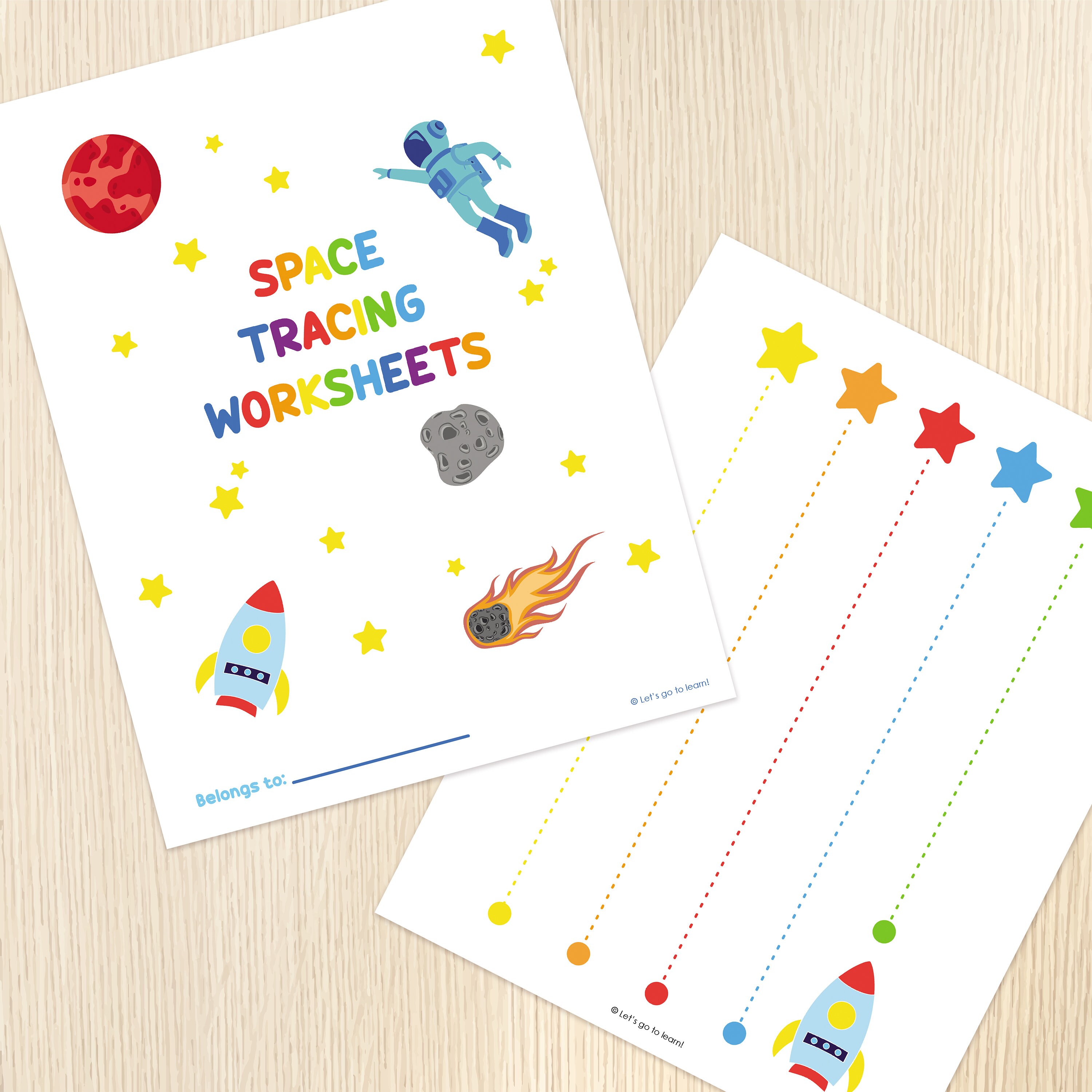
The cosmic design of this printable brings purposeful structure to early literacy and pre-writing practice. Children embark on visual journeys that target specific directional strokes required for future letter formation. Vertical descenders become rocket launches, horizontal paths represent spacecraft trajectories, and looping orbits build the wrist fluidity necessary for cursive and manuscript writing alike. Each page builds spatial awareness by utilizing intentional borders and defined starting points. Directional arrows guide the hand from left to right, reinforcing essential pre-reading and pre-writing habits naturally. Here is what makes this worksheet different: it treats pencil control not as a rigid chore, but as an exploratory flight through the galaxy. Children trace dotted lines to help astronauts reach distant bases, naturally slowing down their hand movements to stay on the path. This careful pacing encourages visual-motor integration, teaching the brain and the hand to communicate effectively without causing hand fatigue or frustration.
Key Learning Outcomes
Engaging with space-themed tracing layouts fosters a multitude of developmental milestones simultaneously. Learners refine their tripod grasp as they maneuver pencils around planetary curves and jagged asteroid fields. Hand-eye coordination improves dramatically as visual focus tracks the movement of the writing utensil across the page. Bilateral coordination stabilizes the paper while the dominant hand executes controlled, fluid strokes. Furthermore, confidence blossoms as children successfully complete each interplanetary trail, paving the way for more complex explorations found within Shape and Line Tracing activities. Consistent practice builds the intrinsic hand muscles required to sustain writing tasks without early cramping or discomfort. Ultimately, children internalize directional consistency, moving steadily from top to bottom and left to right across the sheet.
How to Use This Worksheet
Successful implementation relies on creating a supportive environment where trial and error are welcomed. Begin by setting up an ergonomic workspace with child-sized seating, ensuring feet rest flat on the floor to provide postural stability. Place the paper at a slight upward angle that matches the natural arc of the child’s forearm. Encourage a relaxed tripod grasp, gently adjusting fingers if a tight fist or thumb-wrap appears. Remember that pencil pressure often fluctuates wildly during kindergarten; praise light, steady strokes over heavy, forced lines that tear the paper. For children who need extra sensory input, slip the printed sheet inside a heavy-duty plastic sleeve and let them use dry-erase markers. This frictionless glide offers immediate tactile feedback and allows for effortless do-overs. When children master these cosmic routes, transition them toward forming actual letters using resources like Dotted Letters For Tracing to bridge the gap between abstract shapes and concrete alphabet symbols.
Practical Tips for Parents and Teachers
Scaffolding instruction ensures every learner experiences success regardless of their current motor skill level. Start by demonstrating the stroke in the air, exaggerating the starting point and directional flow before touching the pencil to the page. Verbalize the motion using playful space terminology, such as blasting off upward or looping smoothly around the moon. If a child struggles with a particular curve, gently guide their hand through the movement once or twice to build muscle memory. To extend the activity for older or more advanced learners, challenge them to trace the lines using their non-dominant hand or describe a short story about the rocket’s destination before putting pencil to paper. Varying the writing utensils—such as switching from standard pencils to skinny scented markers—maintains high engagement without altering the core motor objectives of the exercise. Keeping sessions brief, typically five to ten minutes daily, prevents fatigue and keeps enthusiasm exceptionally high.
Age-Appropriate Recommendations
Developmental readiness varies widely across early childhood, making flexible frameworks essential for educators and caregivers. According to the National Association for the Education of Young Children guidelines on developmentally appropriate practice, learning materials must align with a child’s current physical and cognitive capabilities rather than a rigid age bracket. For younger toddlers and preschoolers aged two to four, the focus should remain on broad gross-motor movements and simple pre-writing strokes found in Fine Motor and Pre-Writing Skills collections, such as finger painting lines or tracing massive paths in shaving cream. By the time children reach kindergarten age, spanning roughly five to six years old, their intrinsic hand muscles have matured sufficiently to handle precise pencil control, detailed visual tracking, and directional constraints. For early elementary students up to age eight who still require fine motor remediation, these space-themed sheets offer a low-stakes, highly motivating way to refine foundational stroke control without feeling juvenile.
According to the American Occupational Therapy Association, over sixty percent of a typical kindergarten student’s school day involves fine motor tasks, heavily underscoring the need for targeted pencil control practice. — AOTA School Practice Guidelines
Frequently Asked Questions
How do I download and print these space tracing worksheets?
Click the download link on the resource page to save the PDF file directly to a device. Open the document using any standard PDF reader and select print on standard letter-sized paper.
How does tracing support fine motor development in young children?
Tracing builds intrinsic hand strength, improves finger dexterity, and trains the brain to coordinate visual input with precise hand movements required for writing.
What does the International Dyslexia Association recommend regarding handwriting instruction?
The International Dyslexia Association emphasizes that explicit, multi-sensory instruction in letter formation and stroke directionality is vital for fluent writing and cognitive integration.
Explore More Free Printable Tracing Worksheets
Expanding a child’s skill set requires a diverse library of engaging, targeted practice materials. Beyond cosmic adventures, young learners benefit immensely from exploring thematic variations, structural layouts, and numeric sequences. Discover a comprehensive collection designed to support every stage of early literacy and motor development by visiting KidTraces.com today. Whether looking for seasonal motifs, number formations, or name-writing templates, every educator and parent can find tools that make learning joyful and effective. Browse through options like Alphabet And Numbers Tracing and Seasonal and Fun Themes to keep enthusiasm soaring throughout the entire school year.
Developmental Milestone & Activity Table
| Development Stage | Recommended Daily Duration | Primary Learning Objective |
|---|---|---|
| Preschool & Pre-K | 10 – 15 Minutes | Pencil grip development & basic pre-stroke lines |
| Kindergarten | 15 – 20 Minutes | Letter/number formation & spatial line awareness |
| Early Elementary (Grade 1–2) | 20 – 30 Minutes | Fluency, sentence construction & neatness |
Images References