Introduction
Watch any group of toddlers eager to hold a crayon, and a common developmental truth emerges: children recognize geometric forms and shapes long before their fine motor coordination can actually form them on paper. According to the American Occupational Therapy Association, foundational hand strength and visual-motor integration are prerequisites for functional pencil control. Bridging this gap requires tools that meet developing hand muscles right where they are. That is why the free printable tracing shapes thick lines worksheet serves as an essential stepping stone in early childhood education. It takes the frustration out of early pencil practice by offering wide visual boundaries and generous stroke widths.
💡 Educational Key Takeaways:
- Core Skill: Structured Tracing Shapes Thick Lines focused on developing pencil grip, stroke control, and early literacy/math confidence.
- Target Scope: Suited for homeschoolers, preschool, kindergarten, and elementary learners.
- Best Recommendation: Practice 10–15 minutes daily with ergonomic writing tools to reinforce muscle memory without hand fatigue.
What This Worksheet Covers
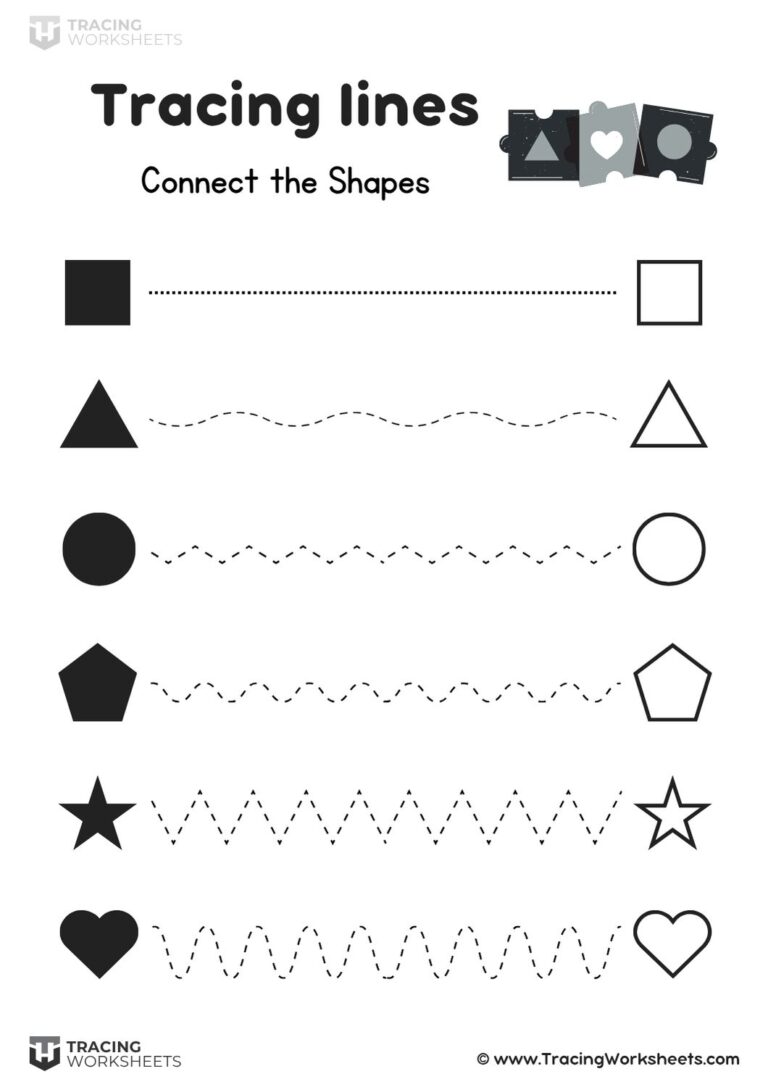
Geometric shapes act as the architectural building blocks for all future handwriting strokes, letters, and numbers. Circles teach continuous curves, squares introduce crisp ninety-degree corners, and triangles require deliberate diagonal control. When these figures are rendered with heavy boundary weights, the visual track remains clear and forgiving for small eyes and unsteady hands. This specific layout reduces cognitive overload, allowing the child to focus entirely on maintaining contact between the writing tool and the paper. It builds the core pre-writing muscle memory needed before transitioning to standard Shape and Line Tracing activities with narrower paths.
Key Learning Outcomes
Working through these wide-bordered geometric pages fosters precise visual-motor coordination, teaching the hand to track smoothly from left to right and top to bottom. Children develop sustained bilateral integration, utilizing a stabilizing hand to hold the sheet steady while the dominant hand maneuvers the crayon or pencil. Directionality improves naturally as learners navigate corners and continuous loops without lifting the utensil. Furthermore, this repeated mechanical motion strengthens the intrinsic muscles of the hand, paving the way for refined pencil grasps that prevent fatigue during longer writing tasks later on. These exercises also support broader Fine Motor and Pre-Writing Skills by bridging gross arm movements with controlled finger-wrist articulation.
How to Use This Worksheet
Success with heavy-line tracing pages depends heavily on setting up an inviting, pressure-free environment at a child-sized table. Begin by sliding the printed page into a dry-erase pocket or laminating it, which transforms the single-use sheet into a reusable canvas for endless practice with chunky dry-erase markers. Encourage starting points with a colorful dot sticker to establish consistent top-to-bottom and left-to-right habits. It sounds simple, and that is the point: removing complicated instructions lets the child focus entirely on the physical sensation of moving the writing instrument along the path.
Practical Tips for Parents and Teachers
Observe how the child grasps the crayon, keeping in mind that a fist grasp is entirely typical for younger toddlers before transitioning to a digital pronate or tripod grip. Model slow, deliberate movements in the air before putting pencil to paper, using descriptive language like “rounding the hill” or “sliding straight down.” Scaffolding the activity means guiding a hand gently over the child’s hand for the first few shapes, then fading that physical support as confidence grows. When fatigue sets in—often signaled by a declining grip or slumped posture—pause the session immediately, because forcing tired hand muscles only reinforces poor habits.
Age-Appropriate Recommendations
For toddlers aged two to four, these thick-lined pages align closely with the National Association for the Education of Young Children guidelines for developmentally appropriate practice, focusing on sensory exploration and gross pre-writing strokes rather than perfection. Children in this bracket benefit from using thick wax crayons, scented markers, or even finger paint directly inside the broad boundaries. As children progress toward ages five through eight, expectations shift toward accuracy, pencil control, and proper tripod grasp maintenance, satisfying foundational readiness indicators outlined in standard kindergarten curricula.
Visual-motor integration and manual dexterity are primary predictors of early writing readiness and school success. — American Occupational Therapy Association
Frequently Asked Questions
Navigating early handwriting tools raises common questions among educators and families supporting young learners at home or in the classroom.
According to the Centers for Disease Control and Prevention, most children can copy a circle by age three and a square or cross by age four. — CDC Developmental Milestones
Explore More Free Printable Tracing Worksheets
Extending this foundational practice opens up endless opportunities for growth across different developmental domains and seasonal themes. Exploring the full library at KidTraces.com provides access to structured resources ranging from alphabet practice to specialized Tracing Worksheets designed for every stage of early childhood. Every child deserves engaging, supportive materials that make learning to write an enjoyable daily adventure.
Developmental Milestone & Activity Table
| Development Stage | Recommended Daily Duration | Primary Learning Objective |
|---|---|---|
| Preschool & Pre-K | 10 – 15 Minutes | Pencil grip development & basic pre-stroke lines |
| Kindergarten | 15 – 20 Minutes | Letter/number formation & spatial line awareness |
| Early Elementary (Grade 1–2) | 20 – 30 Minutes | Fluency, sentence construction & neatness |
Images References