Introduction
Many children recognize geometric shapes and letters long before their fine motor skills can actually form them on paper. According to the American Occupational Therapy Association, foundational hand strength and visual-motor control are essential prerequisites for successful handwriting and drawing tasks. Bridging this gap requires targeted pre-writing practice that prepares small hands for complex strokes. The difficulty tracing triangle offers an intentional bridge between early shape recognition and precise pencil control. Through repeated exposure to angled lines and sharp corners, learners build the dexterity needed for academic success.
💡 Educational Key Takeaways:
- Core Skill: Structured Difficulty Tracing Triangle focused on developing pencil grip, stroke control, and early literacy/math confidence.
- Target Scope: Suited for homeschoolers, preschool, kindergarten, and elementary learners.
- Best Recommendation: Practice 10–15 minutes daily with ergonomic writing tools to reinforce muscle memory without hand fatigue.
What This Worksheet Covers
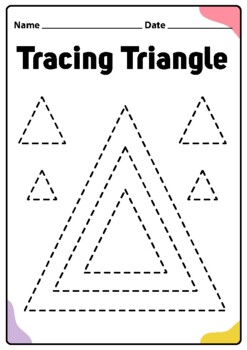
This specific printable focuses on mastering angular paths, directional changes, and bilateral coordination through geometric exploration. Unlike simple curved lines or straight horizontal paths, a triangle demands intentional control as the writing hand shifts direction at each vertex. Tracing these shapes strengthens the small intrinsic muscles of the hand while teaching visual tracking across a defined workspace. It builds upon foundational concepts explored within Shape and Line Tracing galleries, elevating pencil control to the next level of precision. Children learn to manage resistance, maintain consistent pressure, and navigate sharp corners without losing their place on the page.
Key Learning Outcomes
Engaging with this printable fosters superior visual-motor integration by teaching the hand to follow visual cues accurately. Learners develop enhanced spatial awareness as they observe how lines intersect to create closed, recognizable shapes. Hand-eye coordination naturally improves as fingers synchronize with visual input to keep the writing tool on the dotted path. Furthermore, the exercise cultivates sustained attention and pencil stamina, preparing young learners for longer writing sessions found in broader Tracing Worksheets collections. Mastery of these angular strokes ultimately translates into smoother letter and numeral formation later on.
How to Use This Worksheet
Implementation works best when adults introduce the material in a low-pressure, supportive environment that prioritizes effort over perfection. Begin by placing the printable on a flat, stable surface at a comfortable height to encourage an upright posture and natural arm movement. Encourage learners to trace the shape slowly, pausing briefly at each corner to reset the wrist and fingers before tackling the next side. It sounds simple, and that is the point; intentional pacing prevents hand fatigue and reinforces proper biomechanics. For additional sensory feedback, placing the paper over a textured clipboard or a silicone mat can make pencil resistance more noticeable to developing fingertips.
Practical Tips for Parents and Teachers
Adults play a vital role in scaffolding this process by modeling an efficient tripod or quadrupod pencil grasp before handing over the writing tool. If a child struggles with hand fatigue, switching to a shorter crayon or a specialized ergonomic pencil can naturally encourage proper finger positioning. Scaffolding might involve hand-over-hand guidance for the first corner, followed by verbal encouragement as the learner completes the rest of the shape independently. When readiness increases, extend the activity by asking children to draw their own triangles freehand beside the dotted template. These gradual challenges support the progression seen in specialized Fine Motor and Pre-Writing Skills programs without overwhelming the child.
Age-Appropriate Recommendations
According to the National Association for the Education of Young Children guidelines on developmentally appropriate practice, children aged two to four benefit most from large-scale pre-writing strokes and basic shape awareness. At this stage, focusing on gross motor engagement and finger dexterity lays the crucial groundwork for future pencil tasks. For children aged five to eight, the focus shifts toward precision, stroke consistency, and meeting foundational writing standards such as Common Core ELA standard CCSS.ELA-LITERACY.L.K.1.a. Older learners use the difficulty tracing triangle to refine spatial boundaries and master the controlled directional shifts required for complex manuscript letters.
Foundational hand strength and visual-motor control are essential prerequisites for successful handwriting and drawing tasks. — American Occupational Therapy Association
Frequently Asked Questions
Navigating early childhood writing milestones brings up many practical questions regarding materials, readiness, and developmental expectations. Clear answers help caregivers support their young learners effectively at home and in the classroom. Review the frequently asked questions below for quick, actionable guidance on using tracing printables.
Explore More Free Printable Tracing Worksheets
Supporting a young writer involves offering a rich variety of engaging, developmentally appropriate challenges that grow alongside their skills. Beyond geometric shapes, learners often thrive when exploring themed templates, letters, numbers, and lines tailored to their unique developmental stage. Caregivers and educators can browse the entire collection of free resources by visiting KidTraces.com to find activities that make pre-writing practice both effective and enjoyable every single day.
Developmental Milestone & Activity Table
| Development Stage | Recommended Daily Duration | Primary Learning Objective |
|---|---|---|
| Preschool & Pre-K | 10 – 15 Minutes | Pencil grip development & basic pre-stroke lines |
| Kindergarten | 15 – 20 Minutes | Letter/number formation & spatial line awareness |
| Early Elementary (Grade 1–2) | 20 – 30 Minutes | Fluency, sentence construction & neatness |
Images References