Introduction
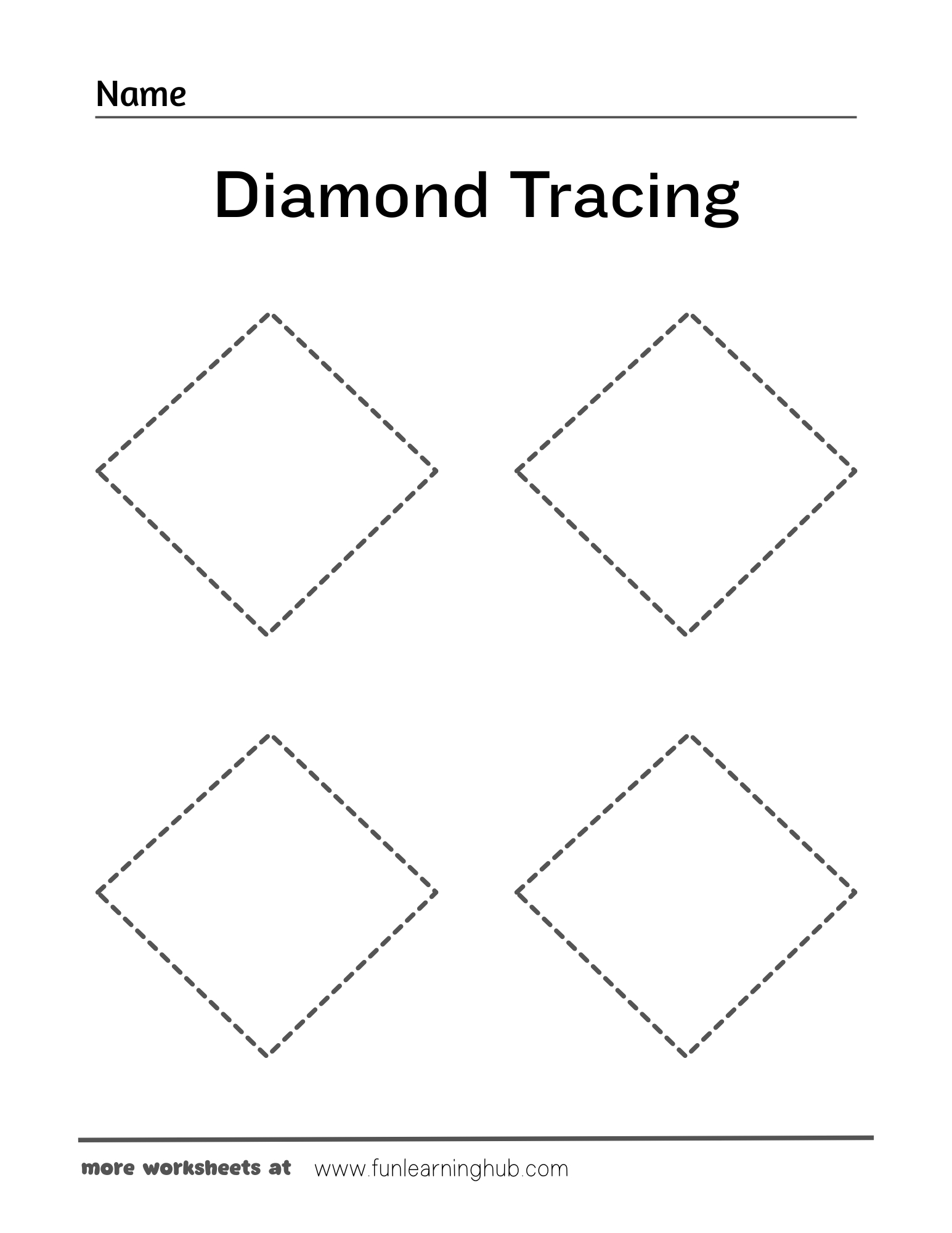
Many children recognize shapes, colors, and letters long before their little hands possess the intrinsic muscle strength required to cleanly form them on paper. According to the American Occupational Therapy Association, foundational fine motor control is built through targeted pre-writing experiences that integrate visual perception with hand-eye coordination. It sounds simple, and that is the exact point. Simple repetitive motions bridge the cognitive gap between seeing a geometric form and executing the precise pencil strokes needed to draw it. Within this developmental landscape, the free printable “i see a diamond tracing” serves as a purposeful tool designed to nurture visual-spatial awareness and pencil control. Supporting early learners through structured shape practice lays the groundwork for future handwriting fluency without overwhelming developing joints and tendons. Explore more in our Shape and Line Tracing collection.
💡 Educational Key Takeaways:
- Core Skill: Structured I See A Diamond Tracing focused on developing pencil grip, stroke control, and early literacy/math confidence.
- Target Scope: Suited for homeschoolers, preschool, kindergarten, and elementary learners.
- Best Recommendation: Practice 10–15 minutes daily with ergonomic writing tools to reinforce muscle memory without hand fatigue.
What This Worksheet Covers
Geometric shape tracing provides the essential bridge between basic vertical lines and complex diagonal strokes. Diagonal lines are notoriously tricky for young children because they require a coordinated shift across the body’s midline and simultaneous control of wrist stabilization. This specific printable focuses heavily on slanting lines, sharp vertex turns, and spatial boundaries. By guiding the pencil along dotted paths to construct a diamond, learners practice stopping, pivoting, and changing direction—all critical mechanics for future letter formation in the alphabet and numbers tracing category. Furthermore, the accompanying sight-word text reinforces early literacy connections, proving that fine motor exercises and reading readiness thrive when paired together. For more related activities, check out our Circle Square Triangle Worksheet”,3″,0″,0%”,1.6666999999999998″.
Key Learning Outcomes
Targeted engagement with geometric outlines builds reliable control over pencil pressure and stroke directionality. Learners sharpen bilateral coordination by holding the stabilization paper steady with one hand while the dominant hand executes the tracing motion. Visual tracking improves significantly as eyes follow the continuous dotted path from top to bottom and side to side. Additionally, structural vocabulary is reinforced when children verbally identify the diagonal lines, points, and closed shape characteristics of the diamond. According to the National Association for the Education of Young Children, active manipulation of writing implements during early childhood directly correlates with sustained literacy success and overall school readiness.
How to Use This Worksheet
Success with shape tracing relies heavily on posture, workspace setup, and readiness cues rather than rigid compliance. Flat surfaces, feet planted firmly on the floor or a footrest, and appropriately sized pencils or crayons make an immediate difference in endurance and grip stability. Caregivers can slide the printable into a clear plastic dry-erase sleeve to encourage low-stakes experimentation, allowing children to wipe away stray marks and try again without frustration. Scaffolding the activity begins with hand-over-hand physical guidance if the diagonal slant feels entirely foreign, slowly fading support into verbal prompts and visual dots as confidence builds across the page.
Practical Tips for Parents and Teachers
Adults should monitor pencil grasps closely, gently encouraging an efficient tripod or quadrupod grasp while avoiding painful tension or white-knuckling. Modeling the correct starting point with a green dot or a verbal cue prevents children from drawing lines backward or from the bottom up. Extending the activity outdoors by drawing giant diamonds in the driveway with chalk or forming them with playdough snakes turns a flat paper exercise into a multi-sensory movement experience. It helps to keep practice sessions brief—often lasting only five to ten minutes—to protect small hand muscles from fatigue and keep enthusiasm high for future shape and line tracing sessions.
Age-Appropriate Recommendations
Toddlers and younger preschoolers ages two to four typically benefit from larger, tactile experiences aligned with the Head Start Early Learning Outcomes Framework, exploring sensory mediums and thick crayons before transitioning to standard pencils. By ages five through eight, children align with Kindergarten and First Grade Common Core standards such as CCSS.ELA-LITERACY.L.K.1.A, where they print all uppercase and lowercase letters efficiently, making precise geometric shape tracing a vital prerequisite. Recognizing these developmental tiers ensures that expectations match physical capability, keeping the learning process encouraging and developmentally appropriate.
Foundational fine motor control is built through targeted pre-writing experiences that integrate visual perception with hand-eye coordination. — American Occupational Therapy Association (AOTA)
Frequently Asked Questions
Tracing shapes and letters builds the intrinsic hand strength, spatial awareness, and fine motor control required for effortless handwriting.
Explore More Free Printable Tracing Worksheets
Expanding a child’s collection of learning materials does not have to be complicated or expensive. Discover a vast assortment of resources covering everything from alphabet practice to specialized fine motor and pre-writing skills right at KidTraces.com. Exploring themed pages like seasonal and fun themes or targeted categories like tracing worksheets keeps young learners motivated day after day. Print today and watch little hands grow more confident with every single stroke.
Developmental Milestone & Activity Table
| Development Stage | Recommended Daily Duration | Primary Learning Objective |
|---|---|---|
| Preschool & Pre-K | 10 – 15 Minutes | Pencil grip development & basic pre-stroke lines |
| Kindergarten | 15 – 20 Minutes | Letter/number formation & spatial line awareness |
| Early Elementary (Grade 1–2) | 20 – 30 Minutes | Fluency, sentence construction & neatness |
Images References