Introduction
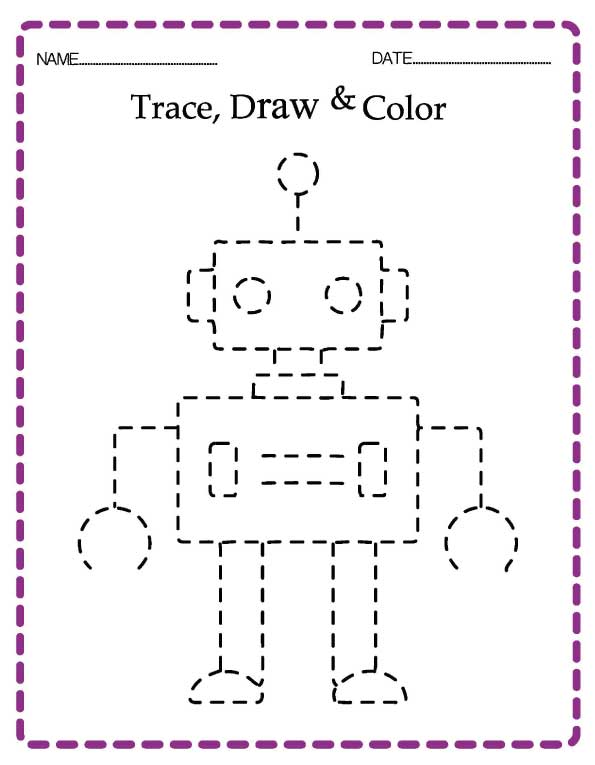
Many children recognize letters, numbers, and mechanical shapes long before their fine motor coordination and hand strength allow them to cleanly reproduce those forms on paper. According to the American Occupational Therapy Association, foundational fine motor control and bilateral hand coordination are essential prerequisites for effective pencil management and early academic success. Young learners often possess rich visual vocabularies and imaginative ideas, yet struggle to translate that internal clarity into steady, controlled pencil strokes across a blank page. Transforming early pencil practice into an engaging, playful mechanical adventure bridges that exact gap between cognitive readiness and physical execution. It sounds simple, and that is precisely the point. The free printable line tracing robot worksheet invites children to guide quirky, friendly automatons along distinct vertical, horizontal, diagonal, and curved paths. Beyond mere entertainment, this targeted resource anchors early pre-writing practice within a thematic context that sustains focus, reduces frustration, and builds intrinsic motivation for foundational literacy and writing milestones.
💡 Educational Key Takeaways:
- Core Skill: Structured Line Tracing Robot Worksheet focused on developing pencil grip, stroke control, and early literacy/math confidence.
- Target Scope: Suited for homeschoolers, preschool, kindergarten, and elementary learners.
- Best Recommendation: Practice 10–15 minutes daily with ergonomic writing tools to reinforce muscle memory without hand fatigue.
What This Worksheet Covers
Visual-motor integration requires the brain and the hands to work in seamless unison, translating what the eyes perceive into precise physical movements. This specific printable focuses heavily on foundational pre-writing strokes, which serve as the indispensable building blocks for all future letter and numeral formation. Children encounter a variety of winding, zigzag, looped, and straight pathways connecting friendly robots to their mechanical destinations. Each distinct line style challenges specific muscle groups in the hand, wrist, and forearm, encouraging fluid dynamic control rather than stiff, rigid movements. According to Reading Rockets, systematic instruction in visual-motor skills helps prevent letter reversals and spatial confusion by establishing reliable directional habits during early childhood. Here is what makes this worksheet different: it treats pencil control not as a rigid drill, but as a dynamic pathway for exploration, allowing young learners to master directional consistency while engaging their imaginations through playful robotics.
Key Learning Outcomes
Executing these varied linear paths fosters a multitude of interconnected developmental achievements for growing children. First, consistent engagement with diverse line and curve patterns enhances visual tracking, enabling eyes to move smoothly across a page from left to right—an absolute necessity for future reading fluency. Second, navigating sharp corners and looping paths builds targeted hand strength and finger dexterity, refining the delicate intrinsic muscles required for an efficient, mature pencil grasp. Third, tracking the precise trajectory from a starting point to a final destination instills a strong sense of spatial awareness and directional discipline. Finally, repeated exposure to structured tracing activities promotes sustained attention span, working memory, and emotional resilience when tackling novel, challenging academic tasks.
How to Use This Worksheet
Successful implementation of early writing tools relies heavily on creating a low-stress environment that prioritizes form over speed. Adults can introduce the page by inviting the child to help the little robot navigate home through a tricky maze of wires and gears. Encouraging children to use their index finger as a preliminary “scouting robot” helps prime the visual pathway before a writing utensil ever touches the paper. Utilizing alternative writing tools, such as short broken crayons, chunky markers, or textured scented pencils, can naturally encourage an appropriate three-finger tripod grasp without demanding forced corrections. Keeping practice sessions brief, engaging, and frequent yields far better results than lengthy, exhausting drills that drain enthusiasm.
Practical Tips for Parents and Teachers
Adults play a vital coaching role during these early writing exercises by modeling proper posture, arm positioning, and paper stabilization with a non-dominant hand. When a child struggles with a sudden zigzag or sharp corner, gentle physical guidance at the elbow or wrist helps demonstrate the necessary deceleration and directional shift. Educators and parents should consistently scaffold the experience, offering thicker writing instruments or larger formats for younger children while gradually transitioning older learners to finer lines and standard pencils. Celebrating small victories, such as maintaining contact with the dotted line for an entire curve, reinforces positive reinforcement loops. Exploring broader developmental resources like Fine Motor and Pre-Writing Skills provides additional strategies tailored to unique developmental stages.
Age-Appropriate Expectations
Understanding developmental frameworks ensures that expectations match a child’s true neurological and physical capabilities. Aligning with the National Association for the Education of Young Children guidelines on developmentally appropriate practice, children aged two to four typically focus on gross motor pre-writing strokes, imitating vertical and horizontal lines using whole-arm movements and fist grasps. Transitioning into ages five through eight, children enter the refinement stage outlined in handwriting curricula such as Handwriting Without Tears, where finger isolation, mature pincer grasps, and precise diagonal line control take center stage. Integrating thematic activities like Seasonal and Fun Themes keeps older preschoolers and early elementary students motivated as their fine motor stamina expands to meet increased academic demands.
Visual-motor integration and fine motor proficiency are primary indicators of early writing readiness and academic achievement in young children. — American Occupational Therapy Association
Frequently Asked Questions
Navigating early childhood writing resources can bring up many practical questions for educators and families alike. Clear answers ensure that these printable materials are utilized to their absolute maximum developmental benefit.
Mastery of foundational pre-writing lines directly correlates with improved legibility, spatial organization, and writing speed in primary school. — National Association for the Education of Young Children
Explore More Free Printable Tracing Worksheets
Supporting a child’s journey toward confident writing requires a diverse toolkit of engaging, developmentally sound resources that grow alongside them. Beyond robotics, children thrive when presented with varied visual challenges that reinforce stroke control, letter formation, and creative confidence. Exploring specialized collections such as Shape and Line Tracing or discovering structured practice through Alphabet And Numbers Tracing offers endless opportunities for meaningful pencil exploration. Every child’s developmental timeline is wonderfully unique, and having access to a comprehensive library makes supporting those individual needs effortless. Discover the complete collection of free learning materials available anytime at KidTraces.com to keep the learning journey inspired.
Developmental Milestone & Activity Table
| Development Stage | Recommended Daily Duration | Primary Learning Objective |
|---|---|---|
| Preschool & Pre-K | 10 – 15 Minutes | Pencil grip development & basic pre-stroke lines |
| Kindergarten | 15 – 20 Minutes | Letter/number formation & spatial line awareness |
| Early Elementary (Grade 1–2) | 20 – 30 Minutes | Fluency, sentence construction & neatness |
Images References