Introduction
Experience shows that many children recognize letters and words long before their developing hands possess the small muscle strength required to form them manually. According to the National Association for the Education of Young Children (NAEYC), meaningful early childhood literacy experiences must integrate hands-on, playful interactions rather than relying solely on rote desk work. When young learners look at holiday baggage, sunhats, or cameras, their brains eagerly connect words to real-world objects. The free printable tracing and identifying vacation items worksheet bridges this exact gap by combining visual recognition with targeted pencil practice. It sounds simple, and that is precisely the point. By anchoring hand control to a joyful, travel-inspired theme, adults can help children build essential writing foundations without inducing the fatigue often associated with formal handwriting drills.
💡 Educational Key Takeaways:
- Core Skill: Structured Tracing And Identifying Vacation Items focused on developing pencil grip, stroke control, and early literacy/math confidence.
- Target Scope: Suited for homeschoolers, preschool, kindergarten, and elementary learners.
- Best Recommendation: Practice 10–15 minutes daily with ergonomic writing tools to reinforce muscle memory without hand fatigue.
What This Worksheet Covers
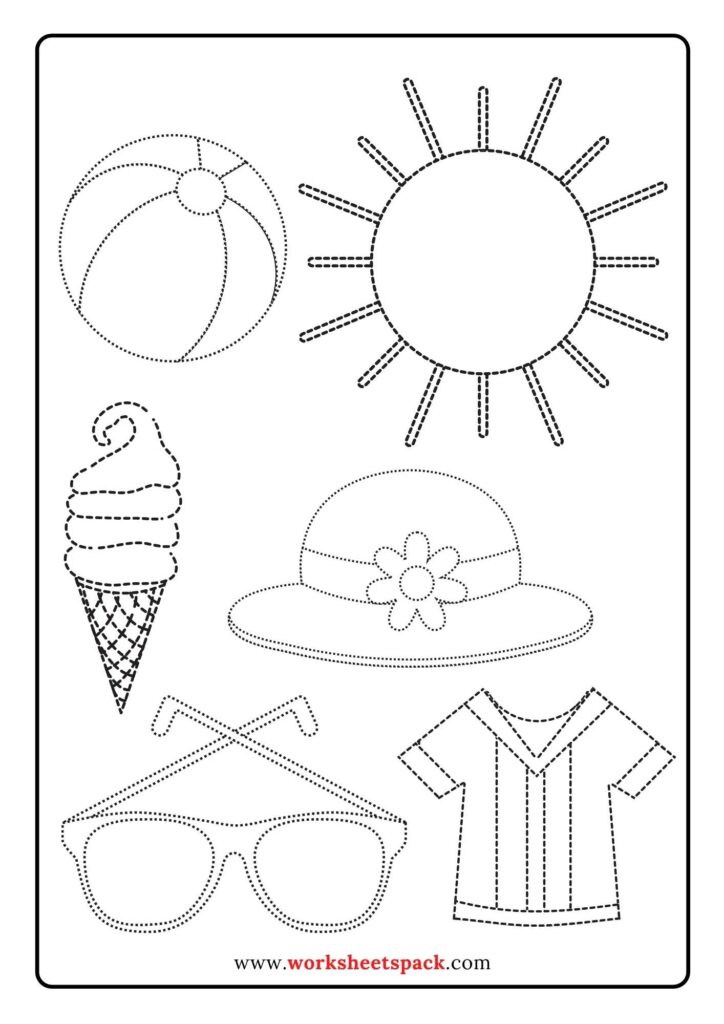
Seasonal and themed printables provide an immediate context that completely transforms how children approach fine motor tasks. This specific resource blends vocabulary expansion with deliberate pencil control, challenging young learners to examine suitcase graphics, flip-flops, sunglasses, and beach balls while guiding a writing tool along dotted pathways. Many adults notice that children resist generic straight-line worksheets, yet they willingly trace a winding path to help a swimsuit reach a travel bag. This natural motivation keeps little hands engaged far longer. Furthermore, the layout deliberately incorporates varied line weights and curvatures, ensuring that the hand moves through multiple planes of motion. Such varied movements strengthen the intrinsic muscles of the hand, which are vital for future academic success and everyday independence.
Key Learning Outcomes
Working through these themed pages yields several distinct developmental milestones that support overall school readiness. First, visual-motor integration improves as the eyes guide the hand to stay precisely on target. Second, vocabulary and early literacy skills flourish because children identify and name each travel object before applying the pencil. Third, bilateral coordination is reinforced as one hand stabilizes the paper while the dominant hand executes the tracing stroke. Finally, children build emotional endurance and concentration, discovering that they can complete a structured task from start to finish. These combined outcomes create a robust platform that prepares learners for more complex activities found in collections like Seasonal and Fun Themes.
How to Use This Worksheet
Success with pre-writing sheets depends heavily on the physical setup and the attitude brought to the table. Adults should begin by observing the child’s natural grasp, gently encouraging an open web space and a functional tripod posture without forcing rigid perfection too early. It helps to invite the child to talk about past family trips or dream destinations, pointing out each vacation object before any pencil touches the paper. Scaffolding the activity makes a tremendous difference for hesitant learners; an adult might lightly guide the child’s hand for the first few strokes before stepping back to let independence take over. When frustration surfaces, pause the session and return later. Writing should always feel like an empowering discovery rather than a chore.
Practical Tips for Parents and Teachers
Simple environmental tweaks can instantly elevate the quality of any tracing session. Tape the worksheet securely to the table using painter’s tape so the paper does not slip away from an unstable hand. Swap standard pencils for shorter, thicker markers or broken crayons, which naturally encourage a proper grasp by restricting fist-like holds. According to the American Occupational Therapy Association (AOTA), building foundational hand strength through varied tactile mediums directly correlates with future handwriting legibility. For extra sensory engagement, try placing a textured tray or a piece of craft foam underneath the printable so the child can physically feel the resistance of the stroke. Extending the activity is just as easy: encourage children to draw their own imaginary travel gear on the back of the page, linking back to resources focused on Fine Motor and Pre-Writing Skills.
Age-Appropriate Expectations
Developmental readiness spans a wide spectrum between the ages of two and eight, requiring adults to tailor expectations accordingly. Younger toddlers in the two-to-four age bracket usually engage with these pages using whole-arm movements, thick crayons, and a palm grasp, focusing primarily on random scribbling across the vacation shapes or making tentative vertical lines. Alignment with the NAEYC Developmentally Appropriate Practice guidelines ensures that educators meet these toddlers where they are, celebrating process over product. By ages five through eight, children transition to refined finger movements, steady wrist extension, and accurate stroke directionality. At this stage, they can independently decode the vacation vocabulary, spell out the associated words, and use resources like Word and Name Tracing to practice precise letter sequencing and spacing.
Foundational hand strength and tactile feedback directly support handwriting legibility — American Occupational Therapy Association (AOTA)
Frequently Asked Questions
Clear guidance helps parents and educators maximize the benefits of daily tracing practice. Below are answers to the most common questions regarding printing, skill development, and expert recommendations.
Explore More Free Printable Tracing Worksheets
Exploring different themes keeps early learners motivated and eager to practice essential hand-eye coordination every single day. Adults can browse an extensive library of educational printables designed by educators and therapists to support every stage of childhood development by visiting KidTraces.com. Whether a child needs extra practice with letter formation or simply loves holiday-themed activities, discovering new resources is always entirely free and effortless. Every printable is crafted to nurture confidence, build muscle strength, and make early learning a genuinely joyful adventure for all children.
Developmental Milestone & Activity Table
| Development Stage | Recommended Daily Duration | Primary Learning Objective |
|---|---|---|
| Preschool & Pre-K | 10 – 15 Minutes | Pencil grip development & basic pre-stroke lines |
| Kindergarten | 15 – 20 Minutes | Letter/number formation & spatial line awareness |
| Early Elementary (Grade 1–2) | 20 – 30 Minutes | Fluency, sentence construction & neatness |
Images References